Tools to Participate: Van Alen Institute's Executive Director Hayley Eber on Agency, Impact and Working Smart

Hayley Eber by Nechama Leitner.
By Julia Gamolina
Hayley Eber (b. Johannesburg) is an architect, educator, and Executive Director of Van Alen Institute, advancing equitable cities through inclusive design. As Principal of Studio Eber, an award-winning New York practice, she works across buildings, interiors, environments, and installations. Formerly Acting Dean at Cooper Union's Chanin School of Architecture, her work has been featured at the Venice, Tallinn, and Milano Biennales. She holds degrees from Princeton, Cooper Union, and the University of Cape Town, and is licensed in New York.
JG: After nineteen years with the Cooper Union, you have stepped into the role of Executive Director at Van Alen last year. What have you been thinking about the most in the transition and as you settle further into your role at Van Alen, and what are you thinking about that nobody is asking you about?
HE: The biggest shift has been moving from leading within an existing institution to building and shaping one. At Cooper Union, as acting dean, my role was to hold the helm steady. At Van Alen, even though the organization has been around for over 130 years, the mission stays the same but nearly everything else is still being defined: charting a new course, inventing programs, and working strategically on where we're headed over the next five to ten years. Running a nonprofit is also new territory for me, including navigating dynamics, fundraising, resourcing, and setting direction from the ground up rather than inheriting one already in motion.
What nobody asks me about is the similarities. At their core, both institutions are about making design accessible, open beyond just the privileged few. Whether that means admitting exceptional students who couldn't otherwise afford an education or giving communities without professional training the tools to advocate for themselves in how their own neighborhoods take shape, the underlying commitment is the same: give people the tools to participate.
The real difference then is orientation. Cooper Union is introverted, conversations largely contained within faculty and students, while Van Alen is extroverted, its networks stretching across city agencies, civic leaders, emerging designers, and a range of other professionals, with funding drawn from broader civic and philanthropic sources.
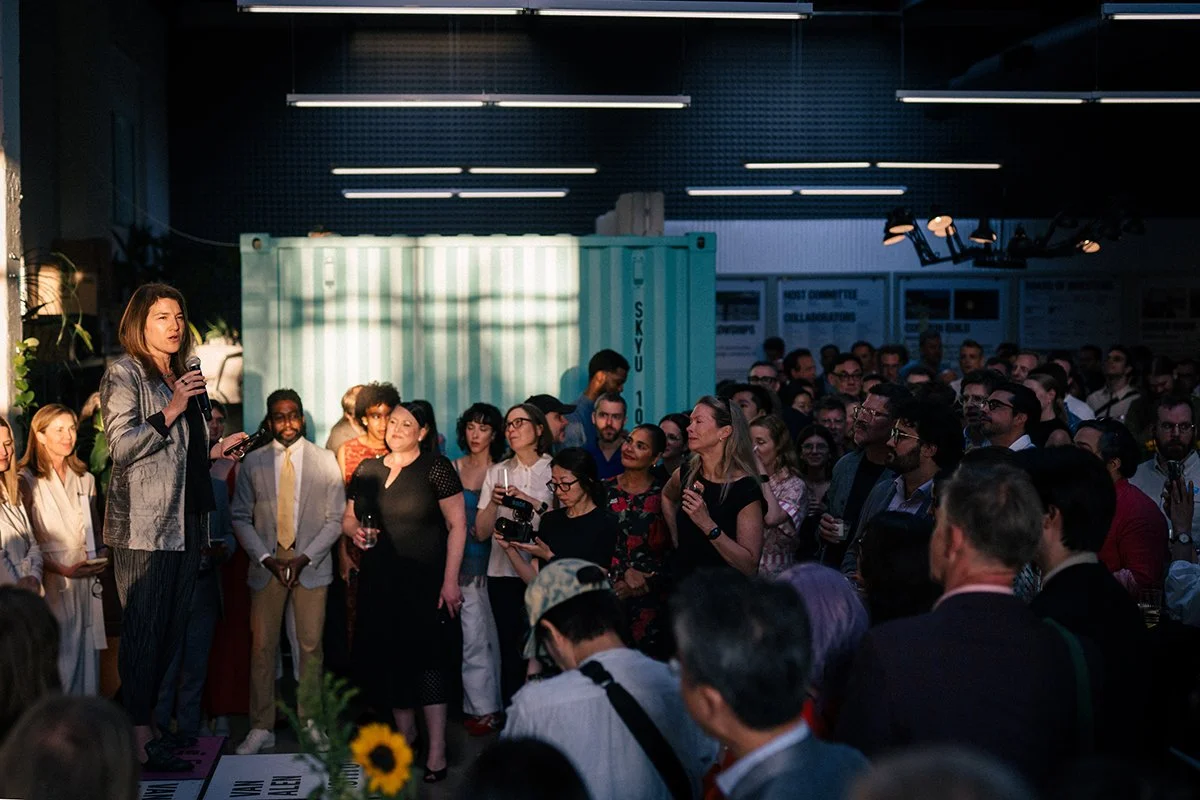
Van Alen Institute’s Bond Street Bash. Photography by Cameron Blaylock.
You studied architecture at the University of Cape Town, at Cooper Union, and at Princeton. What were the biggest takeaways from each institution for you that still inform your work today?
I started at the University of Cape Town in 1995, in the first incoming class after apartheid, which was hugely significant. Studying architecture there was never separate from questions of spatial planning injustice; the two were introduced to me together, as one discipline. That early grounding, that design and justice are inseparable, still shapes how I think about the discipline.
I transferred to Cooper Union for my final two years and was immediately humbled by the level of craft and conceptual rigor. It was also a moment of institutional rupture: John Hejduk had just stepped down as dean, and the school was in the middle of reckoning with its own legacy and direction. Watching an institution question itself that openly, while still holding its standards, taught me something about how institutions evolve.
I then went straight into graduate school at Princeton, arriving the week of September 11, 2001. The shock of that week was disorienting in a way that's hard to describe now. Our fall studio grappled directly with it in real time, each of us defining our own trajectory through the work. It set the tone for the rest of my time there: rigorous critical thinking, an expanded set of design tools, and a constant questioning of our own assumptions.
What was some of the best advice you got early on that has informed your approach to your work and career?
I don't remember who told me this, but it stuck: work hard, then work smart. Early on that meant charrettes and all-nighters, and I'm glad the culture has shifted somewhat since. But the lesson was never really about hours. It's that once you move into bigger roles, the job isn't to work less, it's to know what deserves your attention.
That's as true of parenting as it is of prioritizing a team. I had my first daughter a few years into starting my practice, and having a kid teaches you fast that the hours matter less than what you do with them. At VAI we're a small team, punching above our weight, so prioritizing, delegating, and being honest about where I'm actually useful has become the real skill.
“What drives me is a stubborn belief that design should serve and empower a broader range of people, giving them real agency to shape the places they live.”
Tell me about your most significant professional experiences. What were the biggest takeaways for you?
My most significant professional experience was working on the High Line at DS+R, where I spent about five years. I co-led the competition phase and worked on phases 1 and 2 in close collaboration with the team at Field Operations. It was incredible to work on a piece of civic infrastructure that reshaped how people move through and experience public space, and then to watch what it did to the neighborhood, for better and for worse.
Running my own practice after that was less about single standout projects and more a continuous process of recalibration. One I'm fond of is a temporary performance pavilion we built out of traffic cones, for a client we found on Craigslist, with almost no budget and a ridiculous deadline. It got us real visibility.was all about being resourceful, not only in finding clients and commissions, but also in executing with limited means in an inventive way.
Since then, I have been immersed in the reciprocity between teaching and practice for almost two decades. At The Cooper Union, I have been a passenger, driver, and mechanic. As a student, you're along for the ride, although always questioning and challenging. As faculty, you're in the driver's seat, steering the studio. As dean, you're the mechanic, under the hood working on the structure itself and keeping the whole thing running.
This past June, a cohort from Van Alen traveled to Rwanda with MASS Design Group, and it's become one of the most significant experiences of my first year here. It was our first real test of a new model for VAI's international programming: a partnership with MASS, and a trip built around an exchange of learning with the communities we visited, rather than extraction. Rwanda demonstrated the power of treating design, health, conservation, and community development as an integrated system rather than isolated sectors — a collaborative model I hope VAI can embody moving forward.
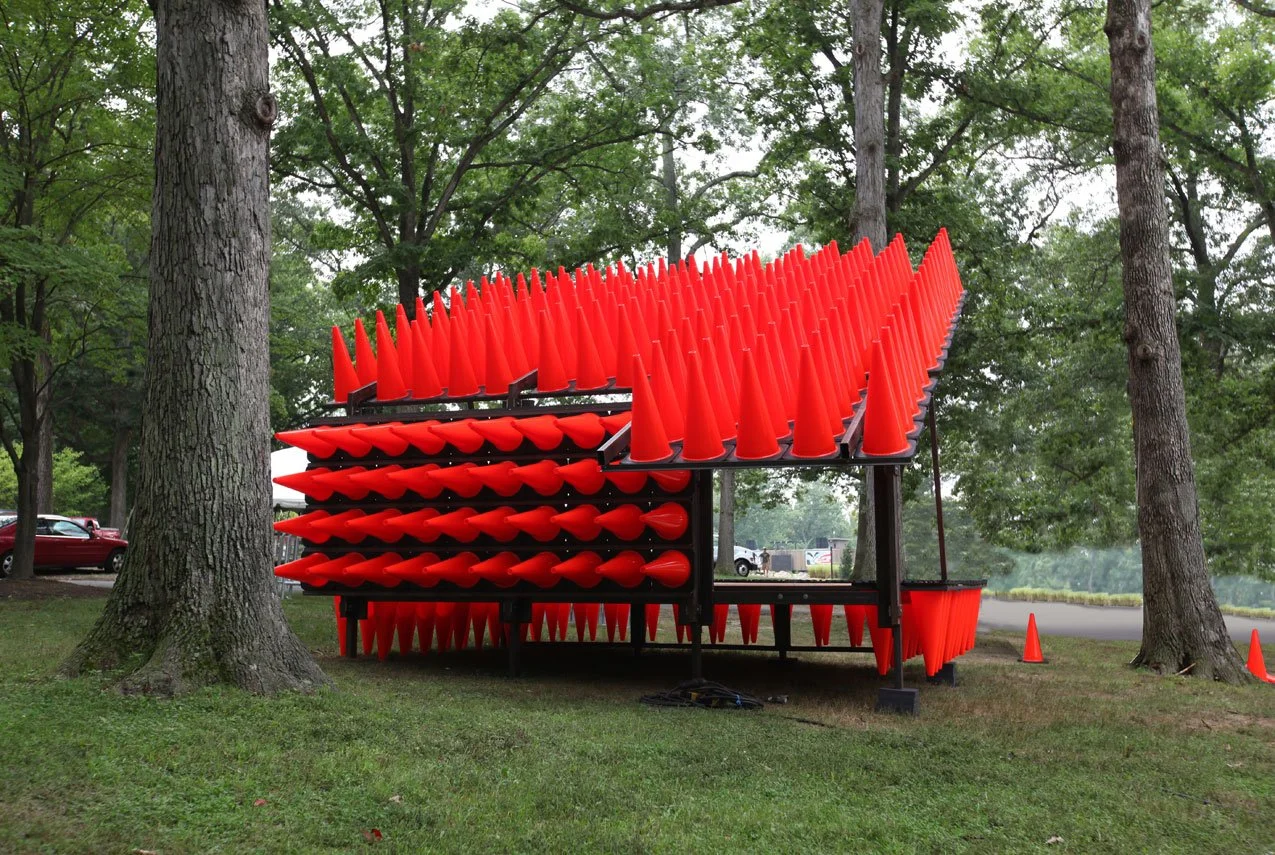
Hedgehog Performance Pavilion by Studio Eber. Photography by Frank Gesualdi.

Everything's on the Table, with Mae-Ling Lokko for the Tallinn Architecture Biennale 2022. Photography by Tõnu Tunnel.
Looking back at it all, what have been the biggest challenges? How did you manage through perceived disappointments or setbacks?
I launched a practice, EFGH, with Frank Gesualdi — which is now Studio Eber — in 2008, a few months before the financial crisis. The timing could have sunk us, and I'm aware how differently that period played out for people with fewer resources or less flexibility. For us, it forced a kind of creativity and resourcefulness that shaped how we worked for years after. We were fortunate to build a relationship with Chop't; we did around eighteen restaurants in total, and it basically kept our office afloat through those years. When they moved the design process in house, it felt like getting cut off at the knees. Losing our main client was tough, but this both freed us up and forced us to do more competitions and chase other types of work, including self-generated and research-based projects.
In more recent years, the biggest challenge was being acting dean during a genuinely tumultuous historical stretch: a pandemic, multiple global conflicts and a national reckoning on race, each resonating on campus in its own way. Students, faculty, staff, parents, alumni, everyone felt these issues intensely, and the job became about creating a place for productive disagreement and honest conversation. In this period, I began hosting community dinners for students and faculty, which shifted the mood from frightened and angry to supportive and collegial: a way of remembering who we were.
At VAI, the challenges look different. Grant funding priorities for nonprofits keep shifting, and there are real gaps in support that aren't always easy to plug, so we're being resourceful about how we frame our work and building new programs and events that can generate revenue alongside it. The bigger challenge, and one we're still in the middle of rather than through, is defining our priorities and setting a strategic direction for the next five to ten years, including identifying all the different audiences and constituencies we serve. That means looking critically at our own past, honestly evaluating our current impact, and figuring out what gets sharpened and amplified in this next chapter.
“It takes time to build your tools, define your audience, and establish your own voice and project. Be patient, play the long game, but act with urgency. And never ask permission.”
Who were your mentors through it all?
Elizabeth Diller has been a constant across nearly every chapter of my career, first as my professor at Princeton, then as a colleague when we taught together, later as the person I worked for directly at DS+R. Before I took the acting dean role at Cooper Union, we had lunch, and my original intention was to convince her to apply for the job instead. She was amused, said she lacked "the dean gene," and turned it back on me. Before every major transition since, I've called her to gut-check and pressure-test that I'm making the right call. She's a sharp, critical thinker, and her read on things is always spot on.
Nader Tehrani is another. I didn't know him well when he asked me to be his associate dean in fall 2019, but within months we were in crisis mode together, first with the pandemic, then a social justice reckoning that hit close to home in our field. He is remarkably balanced and unemotional when making hard calls. He is also the most generous person I know, in the endowments and funds he built for the school and in the quieter work, personally matching students in financial need with donors for example. He's an unmatched multitasker. You learn not to take it personally when he's texting or posting to Instagram mid-conversation.
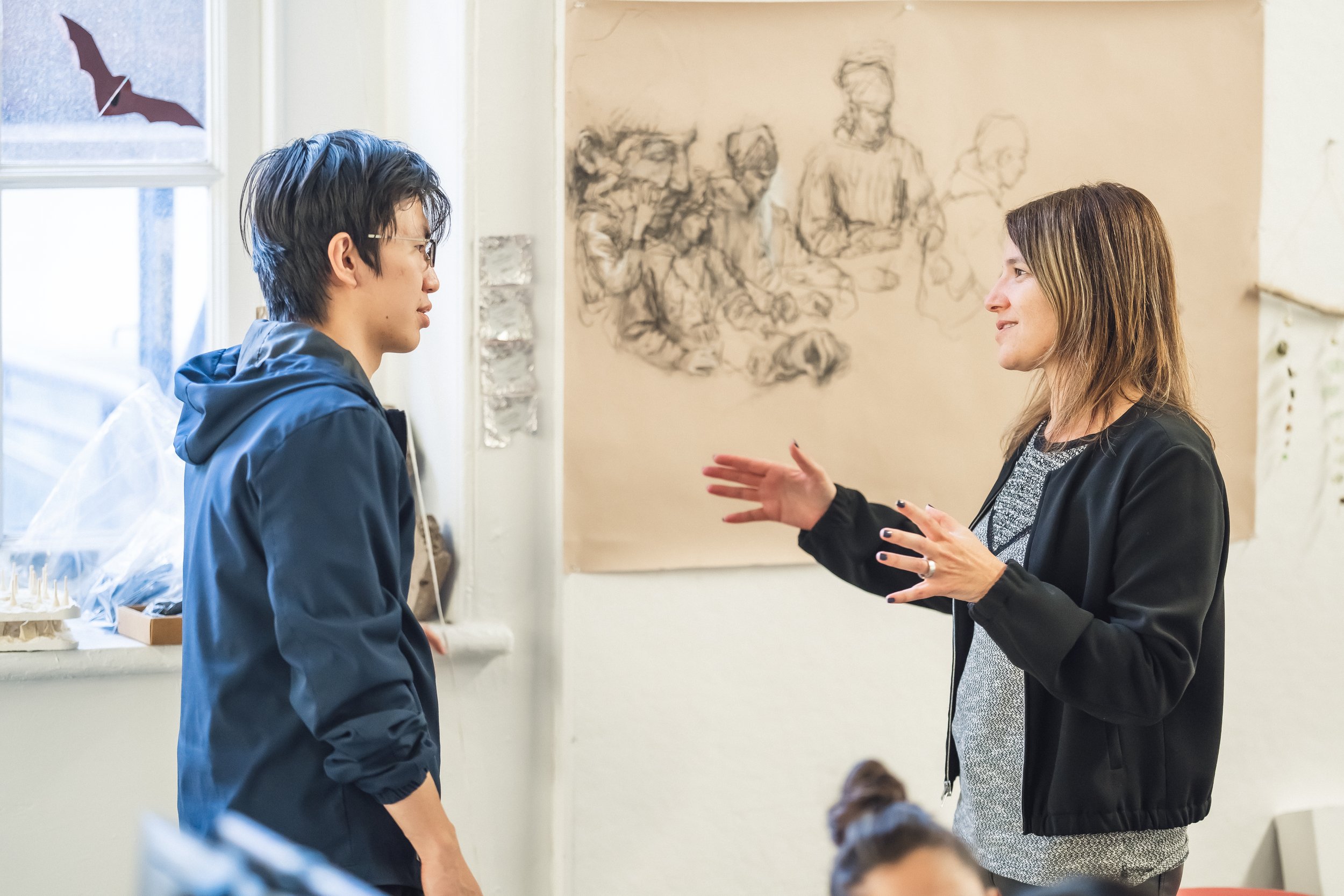
Desk crit in action at Cooper Union. Photography by Ryan Brenizer.
What's the thing that drives you? And what impact would you like to have on the world?
What drives me is a stubborn belief that design should serve and empower a broader range of people, giving them real agency to shape the places they live. For me, impact on the world isn't a single sweeping thing; it's the trajectory of a student, a project, a neighborhood. My hope is that the students I teach at Cooper carry something forward in how they practice, that the communities VAI works with end up with more say over their own built environment, and that my daughters watch their mother take her work seriously without disappearing into it. None of it is one big thing, but it compounds over time.
Finally, what advice do you have for those starting their career?
Architecture is called a practice for a reason; it's constant learning and recalibrating at every stage of your career. There are many modes of practice; the discipline is wide open, and you get to choose the kind of designer you want to be. It takes time to build your tools, define your audience, and establish your own voice and project. Be patient, play the long game, but act with urgency. And never ask permission.
This interview has been edited and condensed for clarity.