Spatial Possibilities: Carnegie Mellon's Tuliza Sindi on Gaps in Exposure, New Models of Practice, and Vocabularies Toward New Futures
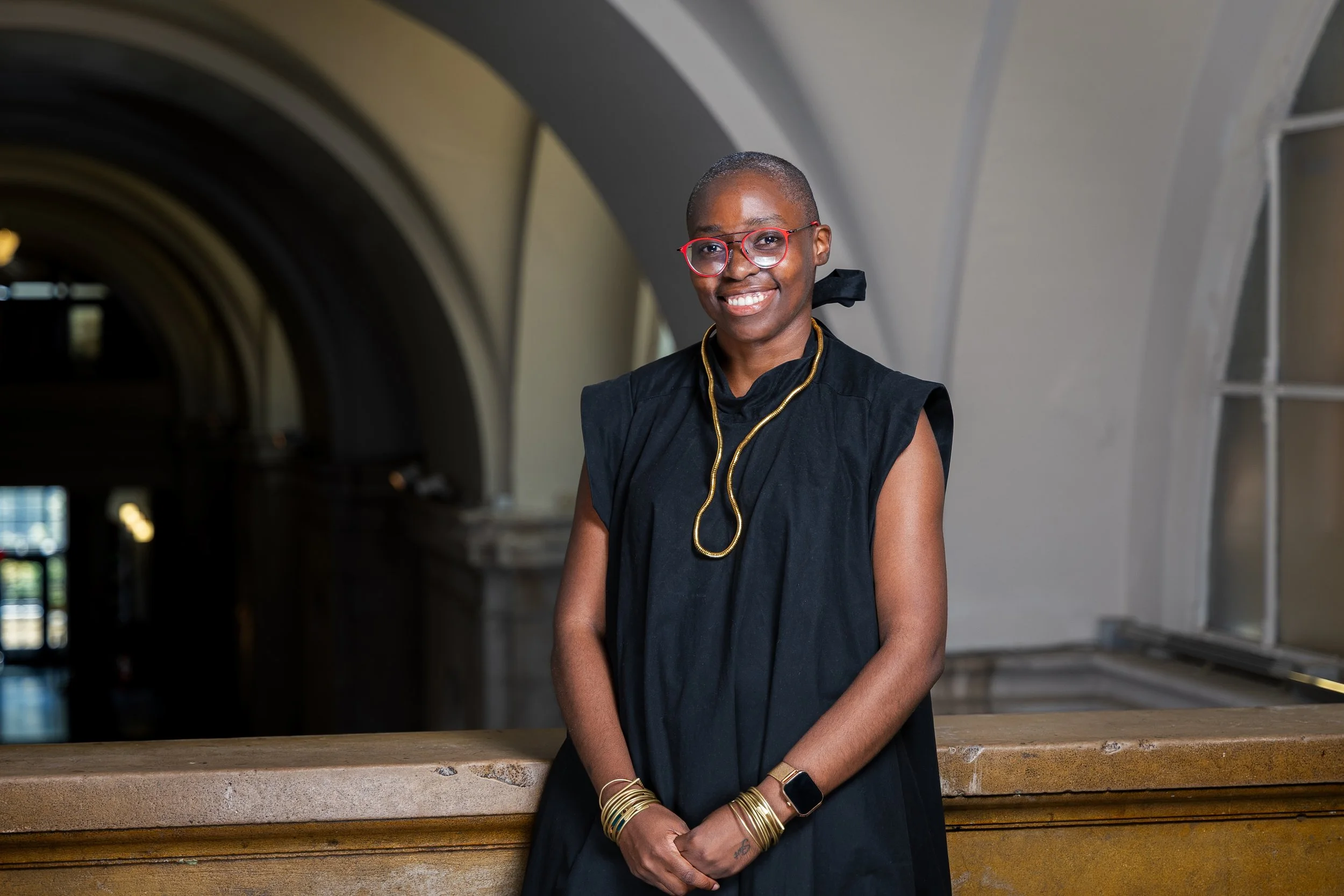
Tuliza Sindi. Photo by Sean Patrick Photography.
By Julia Gamolina
Tuliza Sindi is a South African architecture scholar, practitioner, and curator whose work interrogates land, property, and time through liberatory spatial practices. She is Curator of Public Programs, and Director and Editor-in-Chief of the in otherwards Imprint at Carnegie Mellon University’s School of Architecture, where she was also Ann Kalla Visiting Professor (2023-25). She founded Unit 19 (2020) and the collective room19isaFactory. (2022) to build archival repositories for alternative spatial cosmologies beyond the Western canon.
JG: You're currently in academia as a Curator of Public Programs and the Director of Publications. This is such an important role to be in as you’re setting the tone and sending the message for what students and future practitioners will be paying attention to. What is that for you for 2026?
TS: I understand my role as operating on two parallel registers. On the one hand, I am in service to what the school articulates as its needs. On the other, I feel a responsibility to address gaps I observe in exposure, disposition and critical orientation, whether or not those gaps are institutionally acknowledged or explicitly asked for.
Working in the U.S. has made me even more acutely aware of how the history of the country I grew up in, South Africa, shapes my more overt approach to the political. I’m often, however, engaging with a student body that is largely distanced from political concerns through their immersion into dominant myths and structures of power that quietly shape how they understand themselves and their influence on the world. With this in mind, I’ve approached Public Programs as a kind of parallel curriculum — one that remains fluid and responsive, and that supplements, rather than mirrors, the formal curriculum.
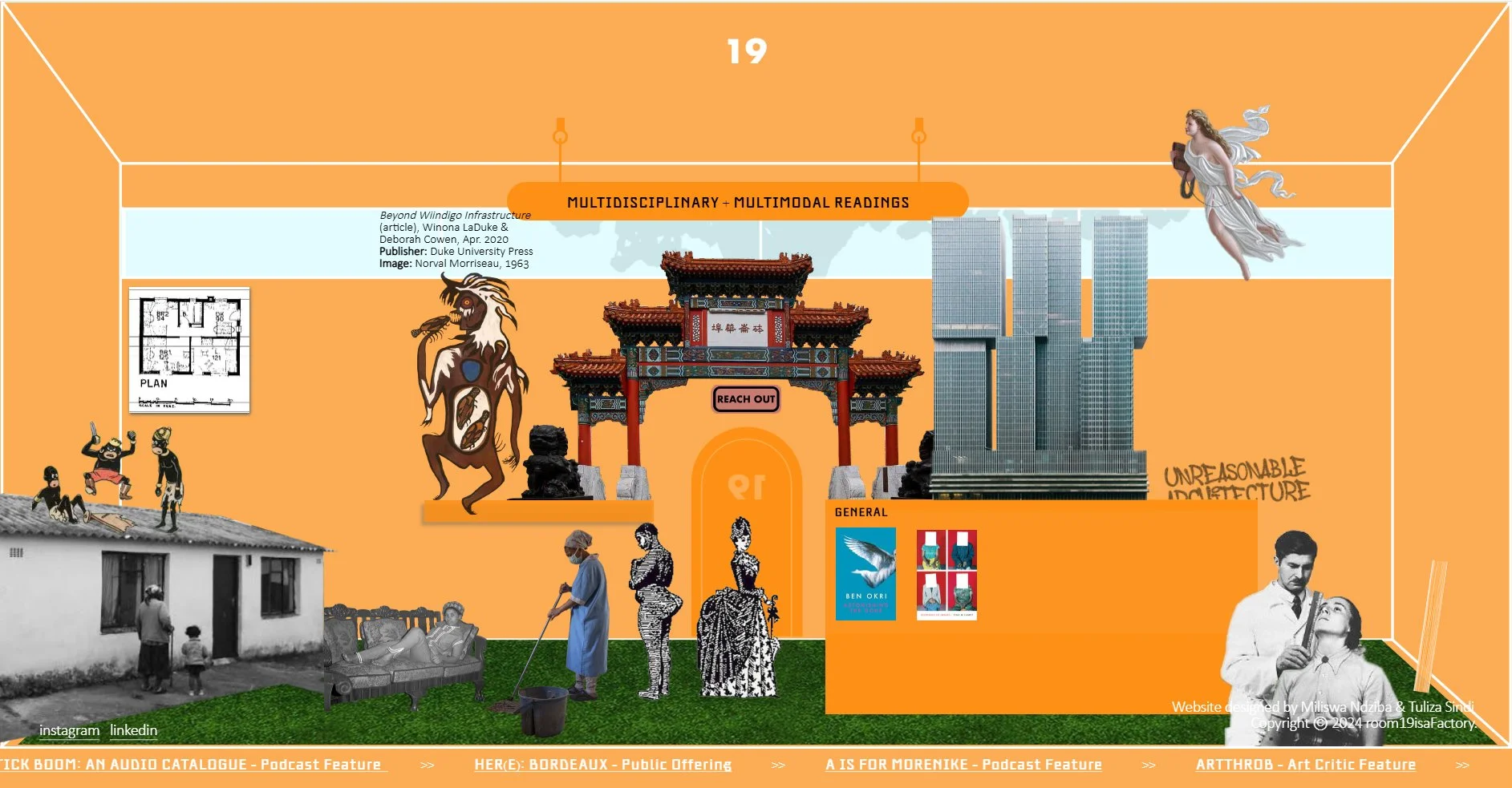
room19isaFactory.’s Library with a constellation of some of the Collective’s seminal readings. Page designed and built by Miliswa Ndziba and Tuliza Sindi.
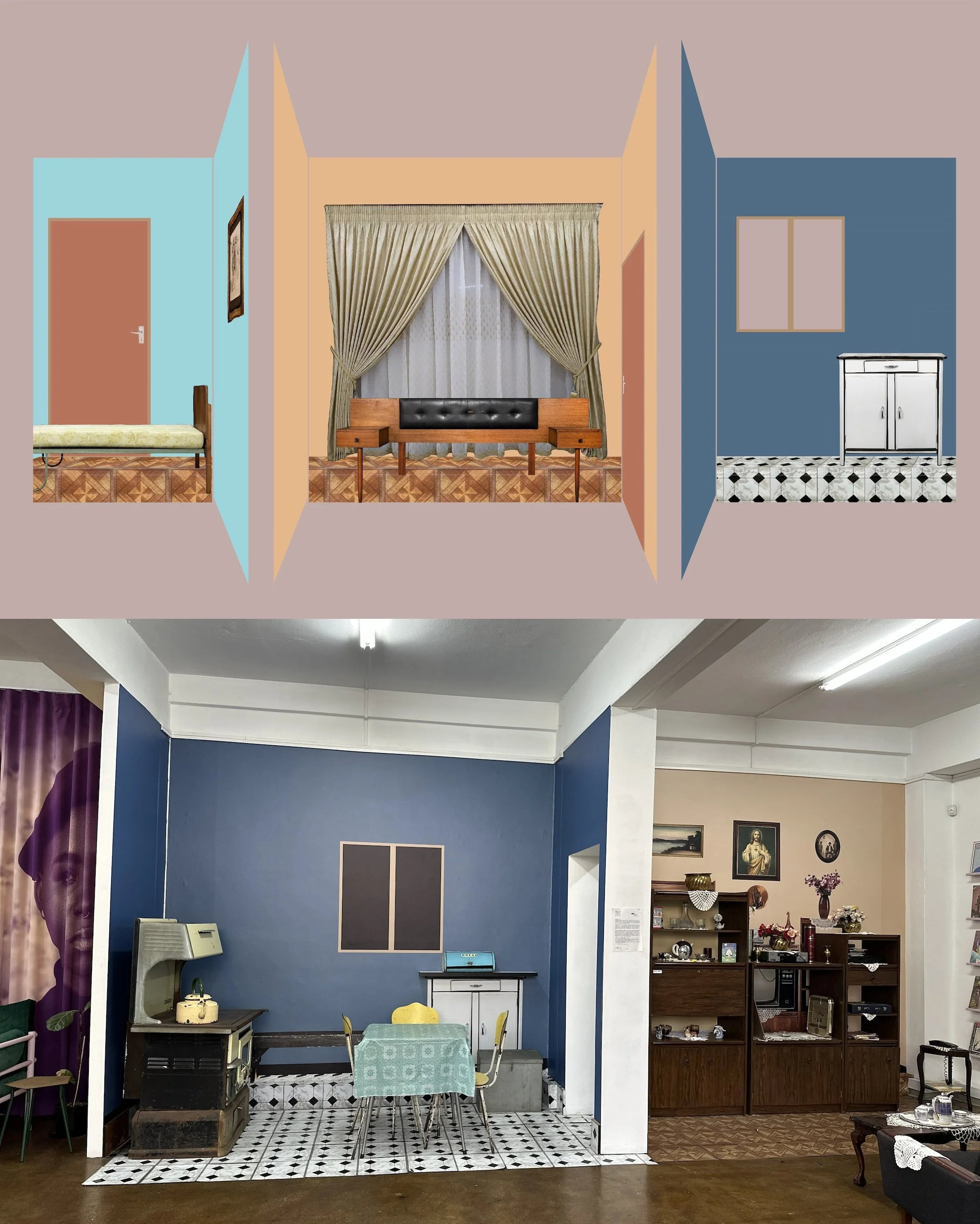
room19isaFactory’s 2024 Within Reason: The NE51/9 House conceptual layout drawing (above) and installation (below) at the Library of Things We Forgot to Remember. Layout drawing by Tuliza Sindi, photo by Thandeka Mnguni.
Tell me also about room19isaFactory, the cross-disciplinary architecture collective that you founded.
room19isaFactory. has been a challenging, worthy, and at times deeply rewarding pursuit. The collective was formed to build infrastructures for architectures not yet drawn, yet materially real for so many of us who are a part of the global majority. It emerged from my experience founding and heading the graduate design research studio Unit 19 at the Graduate School of Architecture (GSA) in the University of Johannesburg (UJ).
Several of our school’s graduating students were eager to establish their new modes of practice within the profession, but found little to no scaffold or safety nets to support those interests. A few of my former students approached me about starting a collective together, and we hit the ground running with our first commission as librarians to the sonic library installation space by Zimbabwean artist Kudzanai Chiurai’s Library of Things We Forgot to Remember. We proposed an apartheid-era Black township lounge installation that held tools of dreaming and time travelling to futures beyond the constraints of the oppressive realities within which Black South Africans were contained.
We went on to receive commissions across Mozambique, Ghana, and Sweden. Over time, our focus began to shift as we found ourselves increasingly drawn to building a resource hub that collects and produces the tools and references that underrepresented cultural groups need to represent their experiences of the world. There is an urgency with which these gaps in representation must be filled, because without them, emerging practices have difficulty both qualifying and clarifying their intents and orientations about the world and its futures.
Now let's go back a little bit — you studied architecture at the University of Pretoria. What were you hoping to do in the world at this time?
Initially, I wanted to design interiors. I grew up watching Nate Berkus on Oprah, Extreme Makeover: Home Edition on the weekends, and playing with my neighbor’s Barbie houses. I would constantly rearrange my bedroom, and my parents even entrusted me to repaint our bathrooms, one of which I painted an aggressive brown that had no business being that intense. Yet every time I entered that bathroom, I felt transported elsewhere, and that for me felt like the closest thing to magic. I was also fascinated by furniture catalogues, and by the fact that two completely different families could purchase the same lounge set or bedroom suite, yet project entirely different meanings onto them.
I want to clarify that I’m not referring to decoration; I’m referring to spatial appropriation. It’s the way urban sidewalks become food markets, stair landings become informal banks for undocumented migrants, or school halls become churches in neighborhoods without civic centers. This is a spatial language of dispossessed peoples who bypass fixed spatial programs to ritualize a different set of cultural and social norms that have not been given accommodation.
What did you learn through studying architecture?
I studied architecture to better understand how that dynamism of the interior could allow people to step into different stories about themselves, or how it could obscure histories, or script alternative futures entirely untethered to the complexities of the present. In that, I was asking about time travel, and a freedom of time untethered to any myth of linearity. I wanted to gain the skills to affect space for anyone wanting to time travel in those ways too; wanting to be made spatiotemporally free.
This orientation made architecture’s obsession with permanence feel jarring to me, especially given how much it scripts and constrains its users’ actions. So, what for me began as excitement about spatial possibility, became an ongoing battle with order, control, rigidity and constraint, and with how permanence forecloses other forms of life.
“I am inspired by spatial practitioners and thinkers who treat space-making or world-building as a fluid, political infrastructure entangled with anthropology, economics, sociology and complex histories, and from that, derive vocabularies toward new futures.”
What was some of the best advice you got early on that has informed your approach to your work and career?
The year I started architecture school, my only Black female professor told me and my Black peers that we would need to work twice as hard to receive half the recognition. I lived by that advice probably for most of my life, and only later recognized the necessity of the warning in buffering us from internalizing our structural illegibility as a personal failure. Being a child of Congolese and Burundian immigrants, for instance, comes with that kind of messaging and pressure. However helpful, it leaves little room for error, uncertainty, risk, dreaming, absurdity, rest, or being human. When I reached the point of complete burnout in my graduate studies I resigned that practice, and chose to accept whatever consequences might come with that, of which there have been plenty.
When I entered academia immediately after graduate school, under Lesley Lokko’s leadership at the GSA, she offered a different instruction, “Do what you believe in – but do it well.” Where the first advice was about perpetual proof of my capacity, the second became about simply claiming space, and if need be, making space to claim.
Tell me about your time in practice.
After graduating, I wanted exposure to as many modes of practice as possible; I was feeling like a sponge, excited to dive into all the profession had to offer. As an intern, I began at Peter Rich Architects, persistently reaching out until he hired me by calling me in to start working on a Saturday morning, just a year after he won World Building of the Year. The scope of work, from Prince Charles’s Earth Award Pavilion, to the design of the sacred Ethiopian site of Aksum nurtured a new range of interests regarding what is possible with and through architecture as a cultural agent.
I then worked with Heinrich Kammeyer, where I learned rigor, care, but also playfulness in detailing. After, I joined Slum Dwellers International, where I encountered nonprofit infrastructure work in deeply disadvantaged urban contexts and learned how money flows through those incentive structures. LocalStudio followed, where I learned guerrilla urbanism and creative engagement within precarity. Then GLM became a brief commercial pivot, and a reprieve, in some ways, where being one body in a larger machine reduced the weight of individual responsibility that came with my positions in the other spaces I had been before that.
What about your time in academia prior to the GSA and Carnegie Mellon?
Returning to the University of Pretoria after this range of exposure was a real reckoning. I was almost immediately confronted by the gaps and silences in the curriculum around the spatial infrastructure of race on which South Africa’s urban framework is founded – and which the profession continues to reproduce through what is known as apartheid spatial planning. I was equally confronted by the racial blind spots of my graduate professors, which I had not fully recognized before. It broke me, and I took a step back to recover and start my graduate studies anew. In that restart, I met Jhono Bennett who co-founded 1to1 Agency of Engagement, that I later worked at, and who introduced me to Lesley Lokko.
At the GSA is where I encountered a Black academic class for the first time, and it was heaven. Until then, about ninety-five percent of my teachers and classmates had been white. This matters because South Africa’s white population makes up about eight percent of the country’s population. So, the messaging I received growing up was that education is the domain of white people; but the GSA offered me a new message.
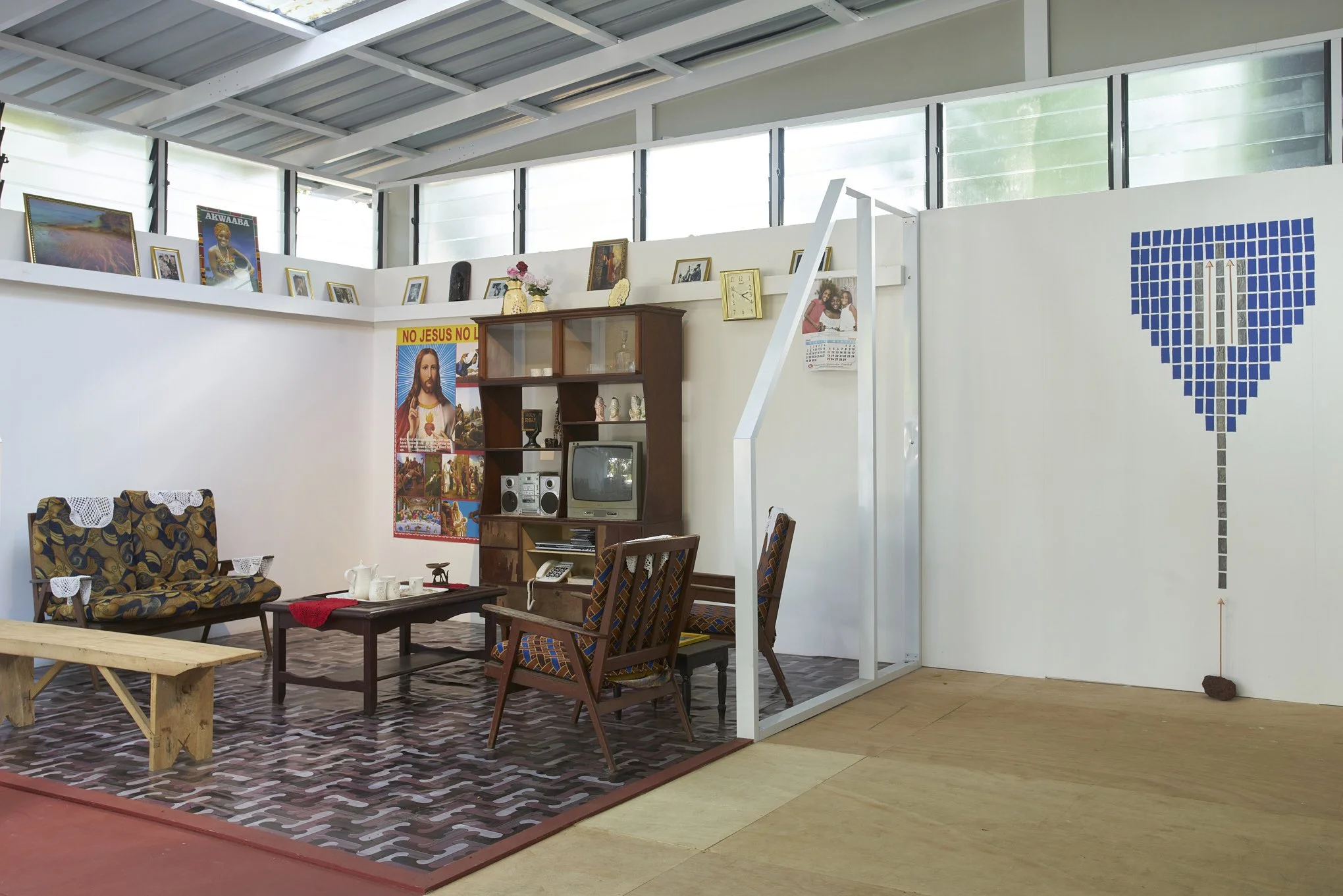
room19isaFactory.’s installation as part of the Delay + Encounter and/or Other Proximate Unknowns exhibition hosted at the Foundation for Contemporary Art (FCA) in Accra, Ghana. Photo by Ivy Gbeze / FCA Ghana.
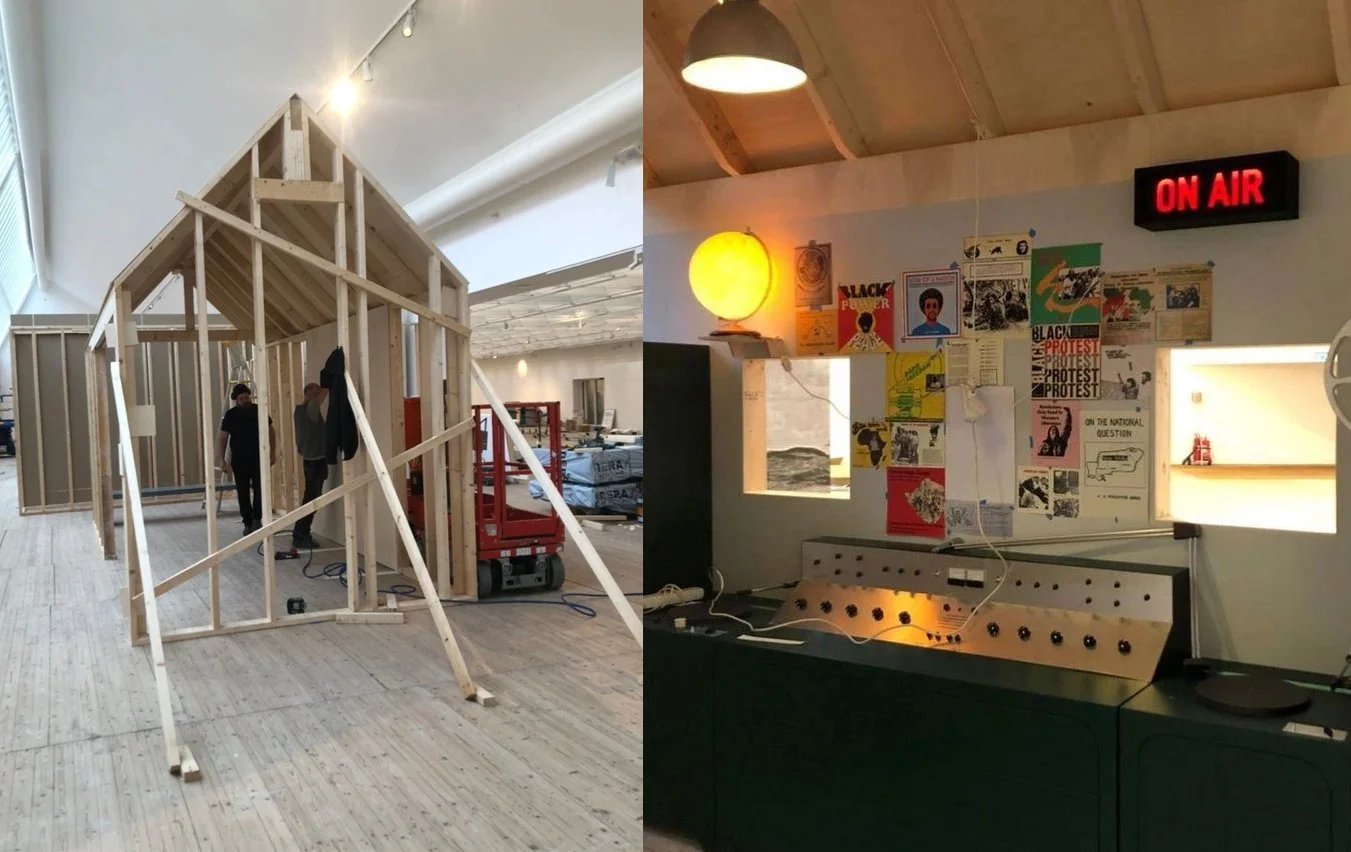
Afrikan Freedom Station installation construction for Kudzanai Chiurai’s “FLIGHT” exhibition contribution designed by Tuliza Sindi. Photo by Helene Toresdotter.
Looking back at it all, what have been the biggest challenges? How did you both manage through perceived disappointments or setbacks?
I feel like I am perpetually beginning again; beginning again to translate myself to new audiences, to new students, to new countries, and uncovering new territories for my unravelling architecture’s entanglements with the worst of our human impulses. Just as I’ve had to deconstruct my religious faith and its white Jesus, alongside gender and race supremacist constructs, I’ve had to do the same of architecture, and it’s a ghastly sight to see it for what it has been and for what it resists becoming: just, humane, and uncontrolling, and cosmologically expansive. So, there is a way that architecture is a perpetually unstable ground with unreliable definitions that my work continually attempts to expand.
Who were your mentors through it all?
Rudolf van Rensburg was my masters advisor who quickly became a model for how I wanted to affirm students who might not easily be understood in architecture school. Jhono Bennett told me that the work that one of my professors said wasn’t architecture, actually was. Dr. Finzi Saidi at the GSA was a consistent source of encouragement, proclaiming that as young black academics, we were allowed to learn out loud, mature into our roles, and be granted the benefit of the doubt, just like anyone else.
Lesley Lokko came like a whirlwind alongside Dr. Saidi’s calm. She showed me how you can challenge and attempt to remake institutions at their core. Anesu Chigariro came on as a resident Unit 19 collaborator and became a critical filter and tuning fork for the work. Miliswa Ndziba was one of the Unit 19 students that joined it in its inaugural year. Her translations of the Unit’s assignments shifted the standard of both what I asked of and could expect of students.
Mary-Lou Arscott, as the then Head of Design Fundamental at CMU, had an unmatched and unwavering level of warmth and curiosity unlike anyone I’ve ever met. Finally, my dearest friend and CMU colleague, Vernelle A. A. Noel, continues to show me, despite her lengthy and impressive accolades, what it looks like to remain human first in the midst of academia’s pressures to mechanize our outputs.
“...trust your references, even if Western canons dismiss them. They provide you with untold ways of thinking that will serve you greatly in hard times.”
Who are you admiring now and why?
I’m drawn to world- and vocabulary-builders like my former students Miliswa Ndziba and Thandeka Mnguni, indigenous scholars such as Dr. Lyla June Johnston and Winona LaDuke, transformative archival works such as The Library of Things We Forgot to Remember, and Chimurenga, and great literary and philosophy cosmologists such as Octavia Butler, Ben Okri, Malidoma Somé, V. Y. Mudimbe, John Mbiti, and Binyavanga Wainaina.
I’m largely uninspired by architecture as a discipline that remains obsessed with property and accumulation, and dresses extractive systems as a generally aesthetic practice. I am, however, inspired by spatial practitioners and thinkers who treat space-making or world-building as a fluid, political infrastructure entangled with anthropology, economics, sociology and complex histories, and from that, derive vocabularies toward new futures.
What is the impact you’d like to have on the world? What is your core mission? And, what does success in that look like to you?
I’d love for modernity to be understood as a cosmology among others, rather than as tautological or natural. I’m writing a book that attempts to clarify the extent of this invisibilized norm, to make room to expand the vocabulary of architecture towards frameworks that no longer negate how the global majority perceive worlds.
I’d also love for the profession to no longer be an elite one. We move as elites, which makes unionizing difficult as we separate ourselves from the idea of being laborers, while we are treated as and costed as laborers. There’s a romanticized ego framework that holds this disjointed image of ourselves together, that we can relinquish so we can reimagine ourselves anew.
We have some of the most important skills in human history, because there has been no point in human history that we have not needed shelter. Yet we manage to make ourselves redundant and obsolete, whether through being accessible to only niche markets like the top one-percent of wealthy people, or recently through our roles being overtaken by AI.
So, what success looks like for me is having new models of practices emerge from my theoretical and design contributions alongside funding models that support speculative futures untethered from territorial production, extraction and perpetual accumulation. This would be about resourcing spatial possibilities simply because they are good for the world, not good for any bottom line.
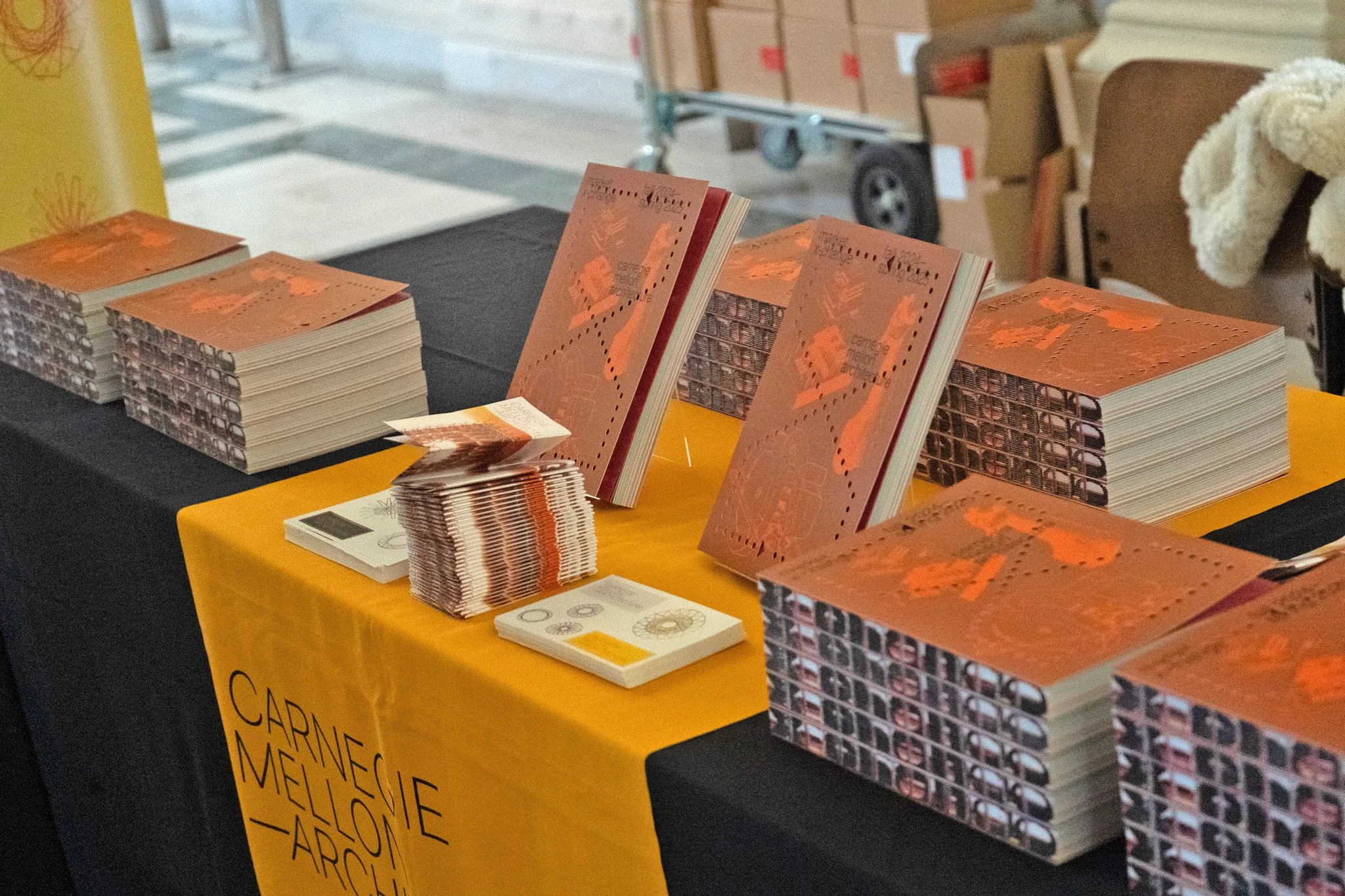
x-change 2024-25 publication launch, edited by Tuliza Sindi, with co-editing support by Meredith Marsh. Photo by Jerome Suraj Karunairaj.
Finally, what advice do you have for those starting their career? Would your advice be any different for women?
For women, embrace the label of the “difficult” woman and don’t apologize for it. You’ll be perceived as such if you stand for anything that challenges norms. You might at times — especially as a Black woman — be expected to shift your ideas to accommodate the worldviews of others. But like the streets say, stand on business. Accept that pushback, doubt, ridicule and rejection are natural outcomes of doing bold and courageous work. Receive it without dismantling yourself to a point where you become unrecognizable to yourself.
Next, trust your references, even if Western canons dismiss them. They provide you with untold ways of thinking that will serve you greatly in hard times. When the world falls apart, they look for the voices that have remained stable and ethically clear to make the paths to the future clearer. So, stay intact long enough to be one of those whose insights they call on to carve paths forward.
Finally, find and make communities where you don’t need to perform competence in front of one another, and where you can break and not be judged or scrutinized as lacking resilience surrounding harmful systems. And work collectively. The myth of the lone genius is simply that; a myth.
This interview has been edited and condensed for clarity.