Living Systems: Renee Kemp-Rotan on Designing With Empathy, Creating Public Space and Transforming Heritage Into Future
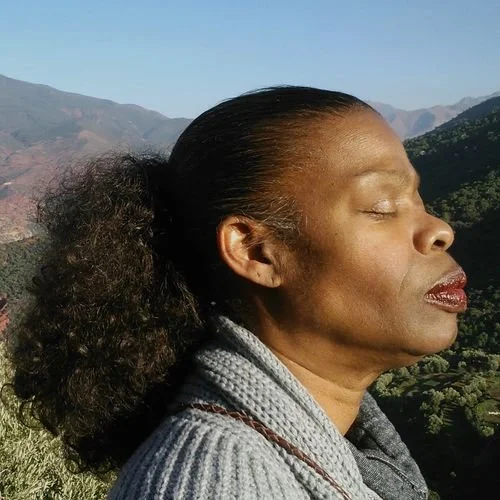
Courtesy of Renee Kemp-Rotan.
By Julia Gamolina
Renee Kemp‑Rotan is a nationally recognized cultural planner, heritage trail strategist, and interpretive design leader with more than thirty years of experience directing large‑scale cultural, architectural, and community‑driven projects for municipal government, international cultural diplomacy, and major public‑realm design initiatives.
Her work sits at the intersection of public history, urban design, and African Diaspora cultural preservation, making her uniquely qualified to lead her most recent-successes, a nomination of Africatown to The World Monuments Fund Watch and her masterminding the design process for The Africatown International Design Idea Competition. She is widely regarded as one of the foremost practitioners working at the nexus of African American heritage, community engagement, and cultural infrastructure development.
JG: To say you have done a lot is an understatement — you've served ten mayors, have traveled the world, and have been involved in basically every type of building design imaginable. Where are you in your career today?
To first give some context to the breadth of things that I’ve done, the Africatown International Design Idea Competition, for example, is my signature international urban design platform. I also created SPADE: The Tools of the Trade, a 52‑card educational game that guides activists from ideation to implementation. As Director of Capital Projects and Urban Design for the City of Birmingham, I played a pivotal role in shaping the vision, planning, public funding, and implementation of $22M Railroad Reservation Park—now one of the city’s most celebrated public spaces. I also directed, designed, and drove the content and production of two-hundred interpretive markers, route planning, and public‑facing design language with life sized photos of pictures taken in the 1960’s and inserted in the places where the movement happened—on the streets of Birmingham. The trail became a cornerstone of Birmingham’s cultural tourism strategy.
Today, I’m at a point in my career where the work feels both expansive and distilled. I’ve accumulated enough experience to understand the mechanics of the profession — how projects move, how teams function, how cities evolve — but I’m still deeply energized by the unknowns. I’m no longer driven by proving myself; I’m driven by sharpening my purpose. My focus now is on work that is catalytic: projects that shift how people live, move, gather, and imagine their futures. My life’s work is archived in Dr. Henry Louis Gates African American National Biography and housed at Oxford University, England.
You were the first African American woman to graduate Syracuse University with a Bachelor of Architecture. Tell me about your years there.
From 1970–1975, Syracuse University’s School of Architecture was widely regarded as a top-tier American program, known for its Bauhaus‑influenced curriculum, rigorous studio culture, and strong national reputation. Though formal rankings didn’t yet exist, Syracuse was considered on par with leading schools like Cornell, MIT, Columbia, and Penn. The program demanded a level of discipline and endurance that reshaped how I thought, worked, and saw the world. Being the first African American woman to earn a Bachelor of Architecture I fully understood while I was studying there that I had to prove that I deserved to be in those studios. The weight of that moment and the responsibility that came with it were cumbersome.
I then spent two years at the Architectural Association in London, immersed in avant‑garde studio culture among future luminaries like Zaha Hadid. My most intellectually stimulating times were actually at the AA under Paul Oliver and Mike Gold of Archigram. My family is exceedingly well-educated; my aunts and uncles and grandparents all went to college. My mother finished Howard University and my stepfather was a Lebanese neurosurgeon…thus the AA as an international environment was a great fit for me.
Finally, I completed my academic arc at Columbia University, earning a master’s degree in Urban and Regional Planning with a minor in International Development. Together, these experiences forged my global, culturally attuned approach to architecture and urbanism.
“The most transformative spaces aren’t always iconic buildings—they’re the everyday places where people gather, rest, argue, celebrate, and build trust. I want to help create more of those adaptable public spaces.”
What was some of the best advice you got early on that has informed your approach to your work and career?
Early in my career, I was shaped by Whitney Young’s call for diversity in American architecture, which led the AIA and Ford Foundation to select twenty Black students nationwide for full scholarships; I was one of them, graduating cum laude from Syracuse. Dick Dozier urged me to “stay curious, but stay steady,” teaching me to probe deeply and endure long timelines. Max Bond, FAIA, encouraged me to “expand the room,” affirming the value of my lived experience. Supported by NOMA leaders—Bob Nash, Bob Cole, Harry Robinson, James Washington, Stan Britt, Roberta Washington, Jack Travis and Bill and Ivenue Stanley—I learned resilience, imagination, and how to carry myself through the work with cultural and political purpose.
What are the lessons you learned from your time as the Urban Policy Advisor to major U.S. cities like Washington, NYC, Atlanta, and Birmingham? What do you see for the future of cities?
I always ask: Who is the city for? Who benefits from growth? Who gets left out? Working across these very different places forced me to understand cities not as static entities, but as living systems shaped by competing needs, limited resources, and the aspirations of millions.
I began my professional journey in New York City, working within some of the city’s most influential urban design and architecture environments. These early roles grounded me in the complexities of dense urban form, public space, and community‑centered design—setting the stage for my later national leadership in civic design.
At the National Endowment for the Arts, I managed the agency’s National Design Demonstrations and National Design Competitions, advancing innovative public‑realm and community‑based design across the country. Working under the leadership of Michael Pittas and Adele Chatfield‑Taylor, I coordinated multidisciplinary teams and shaped national models for design excellence. My tenure at the NEA strengthened my national reputation as a strategist who uses design as a vital nexus for creativity, research, cultural diplomacy and the elevation of public life.
My work as Principal Planner at the Corporation for Olympic Development in Atlanta (CODA) propelled me into the role of Director of Economic Development for Mayor Bill Campbell, where I advanced innovative strategies using urban design to connect neighborhoods and finance viable community projects, especially in Olympic‑impacted areas. I championed development models that linked design excellence with strong market analysis and sustainable funding. Later reappointed by Mayor Shirley Franklin as Chief of Urban Design and Urban Development, I helped sustain Atlanta’s post‑Olympic revitalization. Olympic Atlanta inherited not iconic buildings, but highly functional neighborhood masterplans, enabling a well‑coordinated, community‑driven development machine.
My time in Birmingham taught me that urban design is inseparable from history, politics, and community identity. I learned that every project must begin with an honest reckoning with place—its industrial legacy, civil rights memory, and the lived realities of its residents. Birmingham showed me the power of design as economic strategy, where public space, cultural assets, and infrastructure become catalysts for neighborhood revitalization. I learned the importance of deep community engagement, not as a procedural step but as a source of wisdom, ownership, and long‑term stewardship. I also saw how visionary ideas require political alignment, sustained funding, and cross‑sector partnerships to become real. Most importantly, Birmingham taught me that cities change when design excellence, cultural truth‑telling, and community empowerment move forward together.
Ultimately, the future of cities will depend on our willingness to design with empathy, govern with clarity, and plan with the long arc in mind. My years in urban policy taught me that cities don’t change because of a single project or administration — they change because people commit to shaping them with care, year after year.
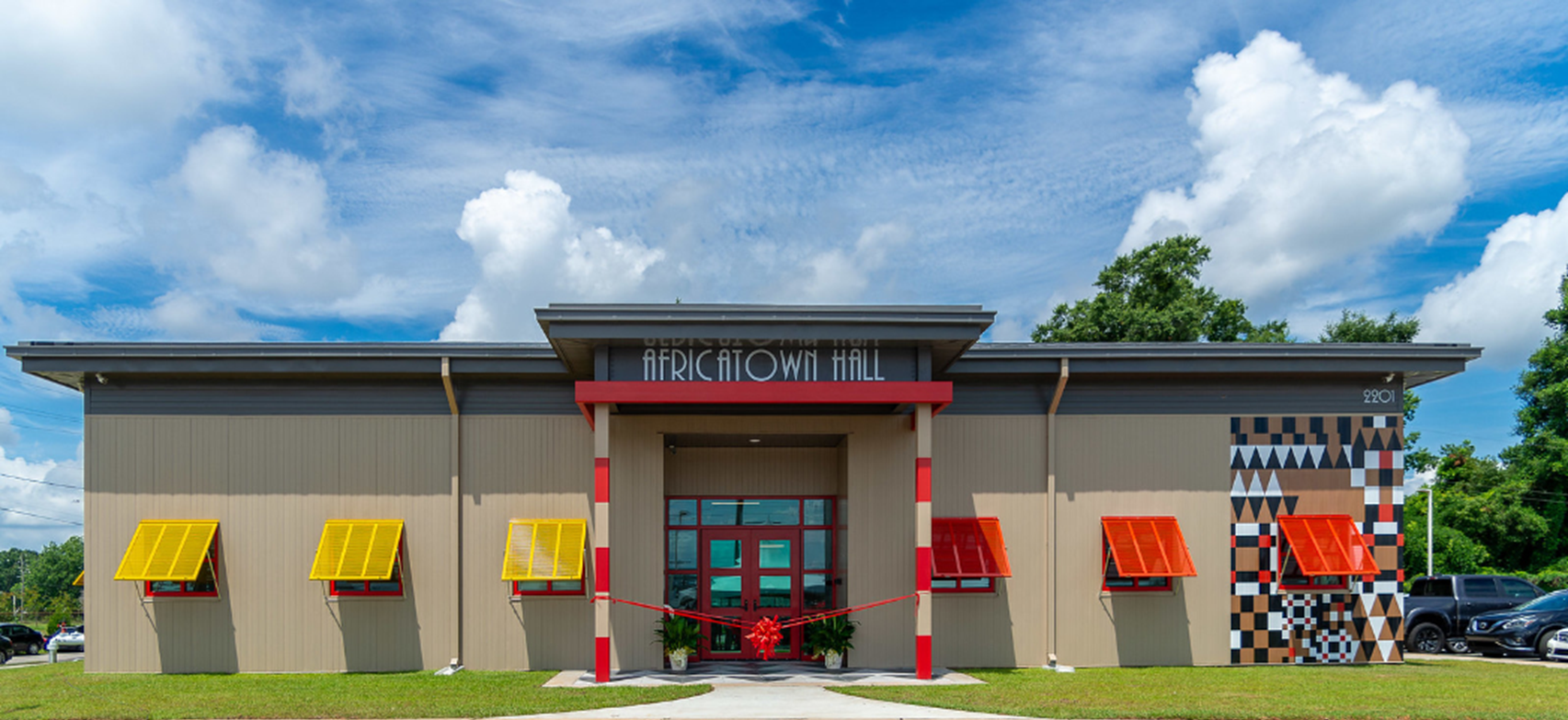
The new Africatown Hall and Foodbank in Mobile, Alabama, 2024. Renee Kemp-Rotan was the lead designer for the project with the Watermark Group. Image courtesy of Renee Kemp-Rotan.
Looking back at it all, what have been the biggest challenges? How did you manage through perceived disappointments or setbacks?
One of the biggest challenges has been learning to navigate a profession and respecting the long arc of impact. Architecture and urban policy both move slowly. You can pour years of energy into a project or initiative and still face political shifts, funding changes, or community dynamics that alter the outcome. That can feel like a setback, especially when you’re deeply invested in the work. I had to learn that progress isn’t always linear — sometimes it’s incremental, sometimes it’s invisible, and sometimes it shows up in ways you don’t expect.
Did you have any mentors through it all?
People rarely get through anything meaningful without some kind of mentor figure, but “mentor” doesn’t always look like the classic wise guide sitting across a table giving structured advice. Often it’s a mosaic of influences—people who show up at the right moment with the right nudge, even if they don’t realize they’re shaping you. Thus, I did not have a singular mentor but rather networks of mentoring relationships, especially through organizations like the National Organization of Minority Architects NOMA, where I met men and women that I now know for more than four decades. If still living, I can easily pick up the phone and talk to CEOs, deans, government officials, community activists, non-traditional practitioners, and students. NOMA is my lifeline both here and abroad.
“...progress isn’t always linear — sometimes it’s incremental, sometimes it’s invisible, and sometimes it shows up in ways you don’t expect.”
Who are you admiring now and why?
Lesley Lokko is redefining architectural education by centering African and diasporic perspectives. I also admire Francis Kéré’s work in Burkina Faso that’s rooted in local materials, climate logic, community participation and cultural identity as foundations. Partners for People (PPP) is a mission‑driven planning and development consultancy dedicated to advancing community‑centered, culturally grounded, and economically viable projects. We worked on the Montpelier Design Competition together.
Rodney Leon is an internationally recognized architect whose practice centers on cultural memory, public space, and the spatial narratives of the African diaspora. Leon is the designer of the African Burial Ground National Monument in New York City and the Ark of Return at the United Nations—two globally significant works that confront the legacy of enslavement and affirm the resilience of African-descended peoples.
Theaster Gates leads a globally influential, interdisciplinary design practice that merges art, urbanism, Black cultural memory, and material transformation. Trained as a potter, Gates approaches cities the way he approaches clay—through restoration, reactivation, and ritual. His practice centers on reclaiming abandoned buildings, reinvesting them with cultural purpose, and creating new models of Black spatial agency. Finally, Atim Annette Oton is an award‑winning designer, cultural strategist, and social entrepreneur whose work sits at the intersection of architecture, craft, community development, and African diaspora creativity. She is the founder of the Calabar Gallery and co‑founder of the Black Design Collective.
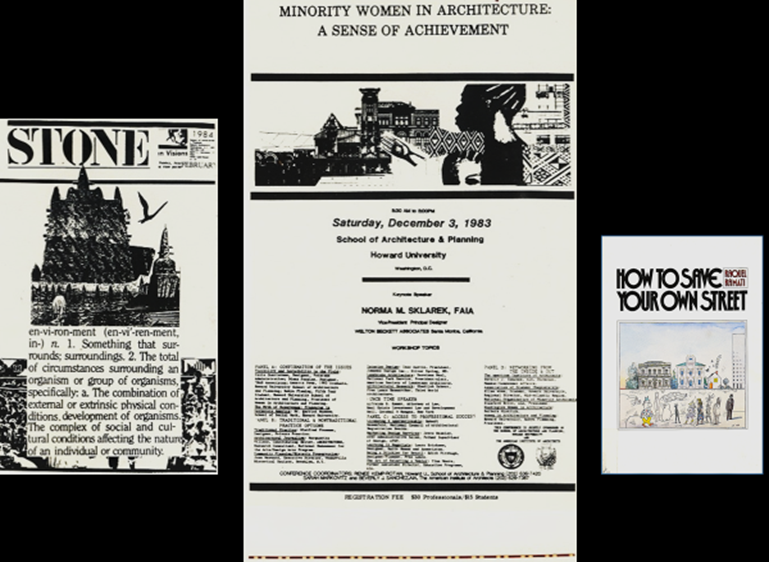
Minority Women in Architecture conference at Howard University, organized by Renee Kemp-Rotan. Poster design also by Renee Kemp-Rotan.
What is the impact you’d like to have on the world? What is your core mission? And, what does success in that look like to you?
I want to help communities protect and reinterpret their heritage—not as something frozen in time, but as a living resource. That means supporting projects that honor local identity while giving people the tools to shape what comes next. The most transformative spaces aren’t always iconic buildings—they’re the everyday places where people gather, rest, argue, celebrate, and build trust. I want to help create more of those adaptable public spaces.
Finally, what advice do you have for those starting their career?
Build your foundation on people, not projects. Technical skills matter, but trust is the real currency. Don’t rush to be the expert. You’ll be invited into neighborhoods, cultures, and histories that aren’t your own. Approach them as a learner. Learn to work across disciplines — the future of cities is interdisciplinary by necessity. Treat heritage as a living system. Cultural heritage isn’t a museum piece—it’s a set of practices, memories, and identities that evolve. Get comfortable with slow wins. Community‑centered work rarely moves at the pace of design studios or development cycles. Patience is a professional skill.
Also travel the world and develop a point-of-view. Because of world travel I met Egyptian Architect Abdul Halim at a conference in Paris where I chaired an International Panel on Gender and Architecture. A few years later I bumped into him in Cairo and he asked me to join his team to pursue design of the Grand Egyptian Museum as he had no time. Another time in Paris, I lectured at the Sorbonne on Josephine Baker and her impact on architecture. Because of that presentation I was asked by Henry Louis Gates, Harvard WEB DuBose Research Institute, to be included in his seminal African American National Biography. Engaging with the world will take you far.
Finally, stay grounded in joy. Even in heavy work, joy remains essential. I find it in community celebrations, in children reclaiming once‑unsafe spaces, and in elders seeing their stories honored. That grounding fuels my interdisciplinary practice—from WILL, my novel‑opera‑ballet on creative resilience, to my children’s books that nurture cultural imagination, to the Africatown competition animations that carried a descendant community’s story to global audiences. Across mediums, I create work that affirms identity, expands possibility, and transforms heritage into future.
This interview has been edited and condensed for clarity.