Entry by Humor: Comedian Dan Mahboubian Rosen on Criticism, Pivots, and Play
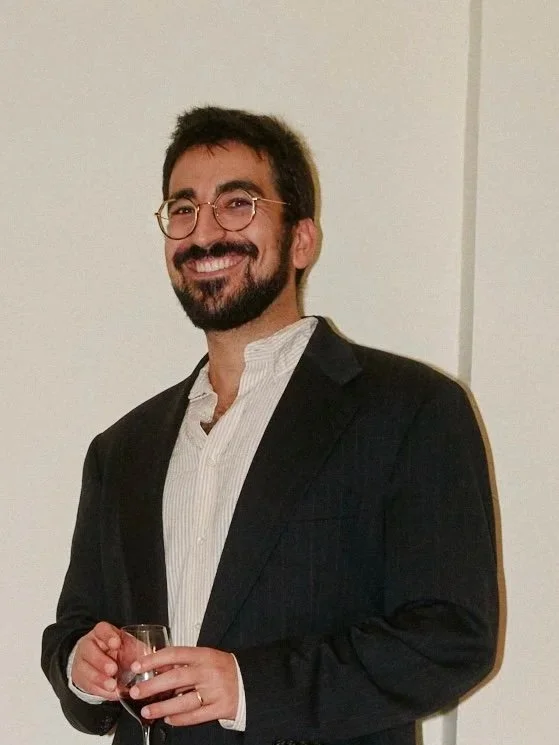
Dan Mahboubian Rosen by Kate Owen.
By Julia Gamolina
Dan Mahboubian Rosen is a comedian and cultural commentator based in New York. His viral videos lovingly satirizing the art and design world have received hundreds of millions of views and have amassed him over 400k followers on social media. Dan was selected Creator To Watch in the NY Comedy festival and the NYTimes included him as part of its Best Comedy of 2023 list. He has been featured in Monocle, Arch Digest, NYMag, Pin-Up, The Observer and Kinfolk. He co-hosts the podcast Middlebrow where he takes a comedic lens to the high and low of culture.
Talk about range — you are, or at some point have been, a comedian, a creator, a cartoonist, a consultant, a critic…have we covered all the “c's”?! What is the throughline for all of your work, the thesis across your output?
I love that challenge of taking niche topics like design or the art world and using comedy and irony to bring in people in who may not be as familiar with those fields but who are drawn in by the references and my passion. I have very strong opinions and takes on the world and I find that the best way to share how I feel is through humor.
I, like everyone else, love your celebrity home critiques. I completely agree that there is too much of creating an aesthetic of status versus creating a home that reflects who they people are and what they love. The homes I love most are ones where you can see the layers of a person's life and experiences.
With all of this, what is then the role of an architect or interior designer when they're commissioned to support someone's vision for their home? Is it to be a guide, an editor, something else? What are some of the best homes that you've seen?
So often I see famous designers just recreate the same home over and over, like alien colonizing people’s interiors for their portfolios, and I just can’t help feeling it’s a failure. Design should be about understanding how the person lives, what they’re drawn to, what their interests are, and guiding them towards the fully realized, and often messy, potential of their needs. The worst is when it’s just a collection of the most iconic design objects of the last century. That’s not good taste. That’s trophy hunting and not how anybody lives, that’s Design Within Reach.
Speaking of taste, I was almost in tears from laughter at your recent video with Rarify, parodying a furniture designer, especially when you got to "taste". Part of the reason I started Madame Architect is because I wanted to have real and fresh conversations in a space where there can be a lot of pretense. What does the architecture, art, and design world need less of? More of? How do we get there?
A sense of humor and some playfulness! Later tonight I’m going to a birthday party for a lamp. That’s just objectively a very silly thing, but it’s a beautiful lamp and filled with history and influence. I feel like there’s a real sense of play that’s missing that I’m doing my part in trying to rectify. That’s not to diminish the power and influence of architecture and design, but you will often hear people talk like they’re Dostoyevsky when they’re 3D printing a mug or something. Relax.
Also this is not just in architecture and design, but criticism of any kind is really lacking in those areas in particular and part of that is just the PR nature of many of the publications. That has allowed a lot of mediocrity to proliferate out into the culture unscathed, and then when people who are not designers or architects see big magazines or institutions feting this type of work it conditions them to see it as de facto “good” when it’s really quite boring and uninspiring.
“Later tonight I’m going to a birthday party for a lamp. That’s just objectively a very silly thing, but it’s a beautiful lamp and filled with history and influence. I feel like there’s a real sense of play that’s missing that I’m doing my part in trying to rectify.”
In the past few years, the preference for video on social media platforms has been impossible to ignore. We now see writers, editors, and founders all needing to be on camera and become content creators. What do you think of this? Do you advise all kinds of professionals to embrace this and learn those skills?
I think this is a horrible development in our society and unfortunately none of us have a choice but to hop on this yellow brick road to hell. The path to success in every field now — comedy, music, the Mayor of New York City — seems to be through the narrow slit of having a knack for short form vertical video content. If you haven’t mastered it then you will soon be eclipsed by less talented people who can.
Once you have achieved some sort of “brand” presence online you do seem to have some latitude to try new things, but you may have to do shameful, embarrassing, evil things to get there. I wish I could wipe this scourge from the earth but I can’t so I play the game and luckily for me — and I guess society — I have other things to say beyond just what got me to this point. Maybe I’m delusional about this.
Substance over format is definitely key. Pivoting now, you've talked about living in a one-bedroom apartment with your family when you were growing up. I very much relate — my parents and brother and I were also in a one-bedroom after we immigrated from Siberia. Can you tell me more about those early years, and about an experience or moment you remember when something clicked for you in terms of what you wanted to do in the world?
Growing up in New York, where everybody has this little box they’re having to figure out how to live in, you become obsessed with what’s possible and how other people live. My parents literally had zero design sense or intent, everything was maximally functional. We had no art on the wall, futons so that we could put away the beds during the day, black file cabinets, like really nothing. At the same time, I would go to friends’ apartments that were palatial and had fifteen-foot ceilings, and everything was carefully thought out and designed, I just remember thinking, “I didn’t know you could do this. I thought you just had to move your pile of stuff from one room to the other when guests came.”
One of my friend’s mom was an architect and she had this incredible sofa, which I later realized was the Polder sofa, and it sort of broke my brain where I just had never really sat and encountered a piece of furniture that was so playful but intentional. It wasn’t just about comfort but had artistic ambitions and that was really eye opening. And then going to Cornell to study art I was surrounded by all these architects in the same school and so you just start picking things up and asking people what they’re doing and developing a greater understanding and taste. By the time I realized I could bring my comedic sensibility to this world I had already sort of developed an eye and familiarity for it, at least enough to make it seem like I knew what I was talking about.
We met studying abroad in Rome, me studying architecture and you the fine arts. Was there anything that you took away from both your time in Rome, and your time in art school, and that you still bring forward in your work today?
The Rome semester gave me a window to focus purely on what I wanted to say with my work, without having to focus on any of the other nonsense of college, either socially or academically. All my classes were either studios where I sort of had a blank slate for the first time, or incredible art and architecture classes that, unlike the ones on Cornell’s campus in Ithaca, were tied directly to the city we were living in, and that completely shifts your relationship to art. Instead of learning about a Bernini chapel with images and floor plans, we would actually go there and touch and feel and smell and experience the space, along with the street around it and how the neighboring buildings and neighborhood developed in relation to it.
When our Italian film teacher would show us Rome, Open City or The Bicycle Thief while actually walking those same streets, my relationship to the art and the city completely changed. What I got out of the grueling hour-long critiques in art school was that you had to be able to defend every decision you made and nothing could be unintentional. And even though I’m making comedic videos now, I still feel that weight to be able to back up what I’m saying with accurate knowledge or conviction and not just make stupid jokes that have no load-bearing truth to them.
That was very much the rigor of architecture school as well, making every “move” for a reason. What was the best advice you got early on that has informed your approach to your output? Did you have anyone you could call a mentor?
I don’t really believe in advice, haha. Everybody has to figure it out on their own and fail and no path is similar. But I did have a painting professor at Cornell, Carl Ostendarp, who spoke very cryptically and his critiques would always be things like, “Make it good.” This drove me insane a bit, but the one that has really stuck with me is, “Make it do what it should be doing,” which I took to mean don’t make it about the thing, but make it the thing itself. Make the work into the object that will have the desired impact.
“What I got out of the grueling hour-long critiques in art school was that you had to be able to defend every decision you made and nothing could be unintentional...I still feel that weight to be able to back up what I’m saying with accurate knowledge or conviction and not just make stupid jokes that have no load-bearing truth to them. ”
I love what you said to NYT about our new First Lady of New York and that she could be an ambassador for the arts, especially in bringing attention to small galleries or emerging artists. Who else are you admiring right now?
There are so many artists doing exciting things despite all the insane headwinds. I love the design work of Adam Charlap Hyman, the art of Tschabalala Self, the music of Viagra boys, the non-fiction writing of Rachel Aviv, the films of Park Chan-Wook, the Criterion Channel, New York Review Of Architecture, the periodical Works in Progress, the podcast Articles of Everything…I could go on and on.
What is your advice for people trying to find what it is they'd like to do, what their highest and best use is...and for those dissatisfied with what's validated?
Well I did say I hate advice…but I will say that you should be very open to signals the world is giving you about what you should and should not do. Very often the thing you want to do is not the thing you’re best at or what you are meant to do, and vice versa, so just be very open to pivoting to something unexpected and not at all what you thought you’d be doing with your life.
Finally, having grown up and spent so much of your life in New York City, what are some experiences everyone living in or coming to New York should have?
If you’re physically able, you really need to bike the city. Biking here totally changes your relationship to the landscape and neighborhoods you’d zip through in a car or under in a train, and you’re suddenly experiencing them in a genuine way. Bike from Washington Heights to Ridgewood. Bike over the footbridge to Randall’s Island and zip under the shadow of the Triborough bridge where Robert Moses had his little fiefdom, where kids are shuttled to play baseball adjacent to an institute for the criminally insane. E-Bike in Central Park at night and play “Central Park In the Dark” by Charles Ives on your iPod Nano. Life-changing.
This interview has been edited and condensed for clarity.