A Realistic Dreamer: Henning Larsen's Head of Sustainability Kritika Kharbanda on Priorities, Champions, and Responsible Architecture

Kritika Kharbanda by Ashok Verma.
By Julia Gamolina
Kritika Kharbanda, Assoc. AIA, LEED AP, is the Head of Sustainability at Henning Larsen. Together with leading the global sustainability team, she develops scalable and implementable solutions across varied project scales to achieve environmental and social impact. She regularly serves as a guest critic and lecturer at various schools, including Columbia University, Harvard University, and MIT. Serving on the ULI NYC Climate and Sustainability Council, she is also the co-chair for AIANY Building Science Committee. With a masters specializing in Energy and Environments from Harvard GSD, Kritika was a Social Innovation Fellow at Harvard Kennedy School.
JG: You've been focused on sustainability at Henning Larsen for three years now — and for some years even before that! How have you seen the efforts around climate initiatives evolve, both at the firm, in the industry, and in the world at large, evolve over these years? What are you prioritizing today in terms of your role?
KK: A year after finishing my undergrad in architecture in India, I was able to secure an internship in Henning Larsen’s Sustainability and Innovation team, located at our headquarters in Copenhagen. Back in Copenhagen, sustainability was not a mere tag, but a way of life. I would bike everywhere, no matter the distance. There was an ingrained sensitivity to resources — for example, the supermarkets did not run out of toilet paper during COVID-19 — and the ability to prioritize nature as something which should not be manicured, but, as the word itself, natural. This experience really shaped me as a person and what sustainability meant to me.
On the work side, in Copenhagen, the conversations were already very well ahead of the global trend, focusing on materiality, embodied carbon, adaptive reuse or transformation and circular economy. The city heavily relies on wind power for city electricity, which meant that the grid was very clean and pushed focus on embodied carbon for decarbonization.
However, the meaning of “sustainability” varies a lot across Henning Larsen’s design studios. In Norway, Singapore, and Canada, we are seeing a big emphasis on biodiversity, nature-based solutions, and urban resilience. Here in the US, our projects still very much focus on reducing operational carbon. New York City now is starting to focus on circular economy with the NYC Circular Design Guidelines. There seems to be a big focus in most US states on adaptation now, with more frequent extreme weather events and resilience against flooding is a growing need.
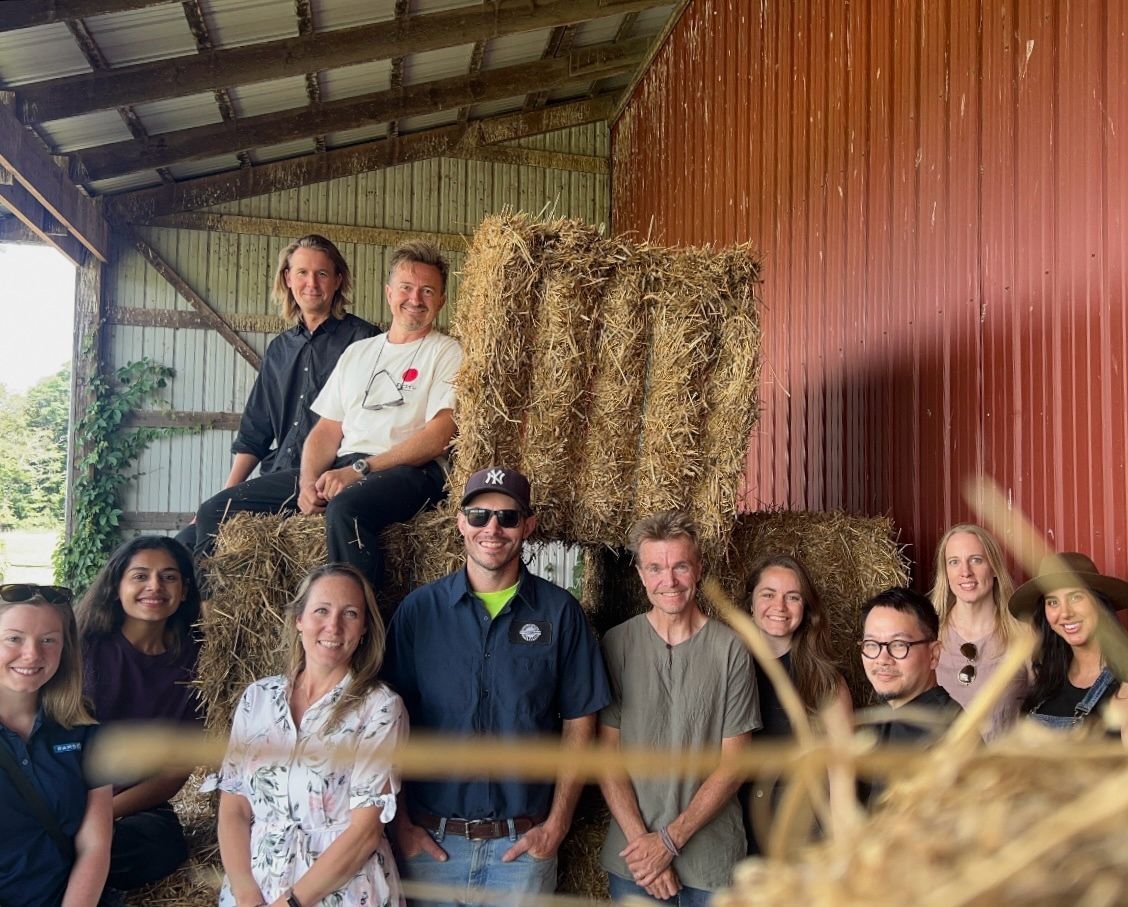
Farm to home. Photography by Eugene Chang.

Holcim Foundation Fellowship’s North America “Decarbonization at Scale” event at the Center for Architecture. Photo courtesy of the Holcim Foundation.
Now let's go back a little bit — you studied architecture in India and then went on to the GSD to focus on the environment. What were you looking to do in the world for both degrees?
Both of my parents are architects in India and usually the daily dinners would be accompanied by an ambient soundtrack of architectural discussions. I do love the creative aspects of designing or shaping a space but am also cognizant of the power a designer holds. Back in India, I was working for leading firms where I would get to work on developments that were as far away from any inkling of sustainable thinking as a Mars Rover from the Earth. These are business-as-usual, concrete structures with heavily glazed envelopes. I learned that this is what I do not want to design. My definition of creating impact as an architect or a designer does not lead to a visual aesthetic output but to a product of environmental and social process.
Before going to the GSD, my time in Copenhagen further fueled my desire to find the niche in impactful design, and I ended up pursuing a Master’s in Design Studies, specializing in Energy and Environments. Sustainable design or responsible architecture is still very much a niche I’d say, and it’s a small community of people who feel the urge to maneuver design decisions for the betterment of the planet and the people. At the GSD, due to my stint in Copenhagen, I was already equipped with the technical skillset, so I was able to tailor my two years very strategically. I waived off classes at the design school and instead took classes at MIT and at Harvard Business School. I also spent two years building a start-up, which is now called Pathways AI (previously Cardinal LCA), which allowed me to do the Social Innovation and Change Initiative fellowship at Harvard Kennedy School. Therefore, my last year was all about gaining interpersonal skills, like learn tricks for effective negotiation, pitching for fundraising, and facing my worst fears of getting out on multiple stages, as a first-time founder in a foreign country.
“My definition of creating impact as an architect or a designer does not lead to a visual aesthetic output but to a product of environmental and social process.”
What was some of the best advice you got early on that has informed your approach to your work and career?
We are living in a fast-paced world but working in an industry where projects can sometimes take years to come to fruition. As someone whose right-brain is all about simulations and data, and whose left-brain speaks to designers and brings the storytelling, I can get exhausted continuously switching. I also often work simultaneously on many projects at the same time, and at the end of the day feel that I could have done a better job in pushing the needle on a certain project had I given that more attention and care.
The golden advice that I got, and that I swear by, is that not all battles are worth fighting. Sometimes it’s okay to not “have your way” when a client is not as ambitious and it seems to do the project more harm to keep pushing. Letting go is okay. Also, consistency is key. Going back to the fast-paced nature of the world — sometimes I do feel that I am going toward stagnation and not making progress at work or even in personal life. But a consistency mindset and patience as you work toward a long-term goal can bring you benefits sooner than you think!
You worked as an architect a couple of years before focusing specifically on the environment. Tell me about some of your most significant professional experiences and what you learned from them that you apply in your role today.
One recent project I learned a lot from is a very small pavilion, 200 square feet, called KlimaKover. KlimaKover, is a modular and autonomous cooling shelter, which uses an innovative Membrane-Assisted Radiant Cooling (MARC) technology incubated by University of Pennsylvania, and the shelter is designed by Henning Larsen. It’s a project that was made possible by a generous grant from the Ramboll Foundation, and I ended up acting as the Project Lead for one year, having no prior experience. This was a crash course on contracts, workplans, procurement, permitting, inspections and navigating red tape.
However, the noteworthy lessons I learned include first and foremost setting the right expectations among all collaborators on a project. Bridging the gap between academia and industry is very tough, since they both work on very different paces and it’s easier to approach experiments in academia whereas in the industry, everything triggers a new set of rules and code requirements. Aligning on goals early on and establishing effective communication is key.
I would also say that, as someone who works in climate technology and scaling innovation, I think of myself as a realistic dreamer. My approach sometimes is not asking for permission but asking for forgiveness afterwards. Now this of course sounds like tricky business, but knowing where you can tread and lean toward slight risk can often lead to great results. Knowing the boundaries and risk tolerance is very important as well.
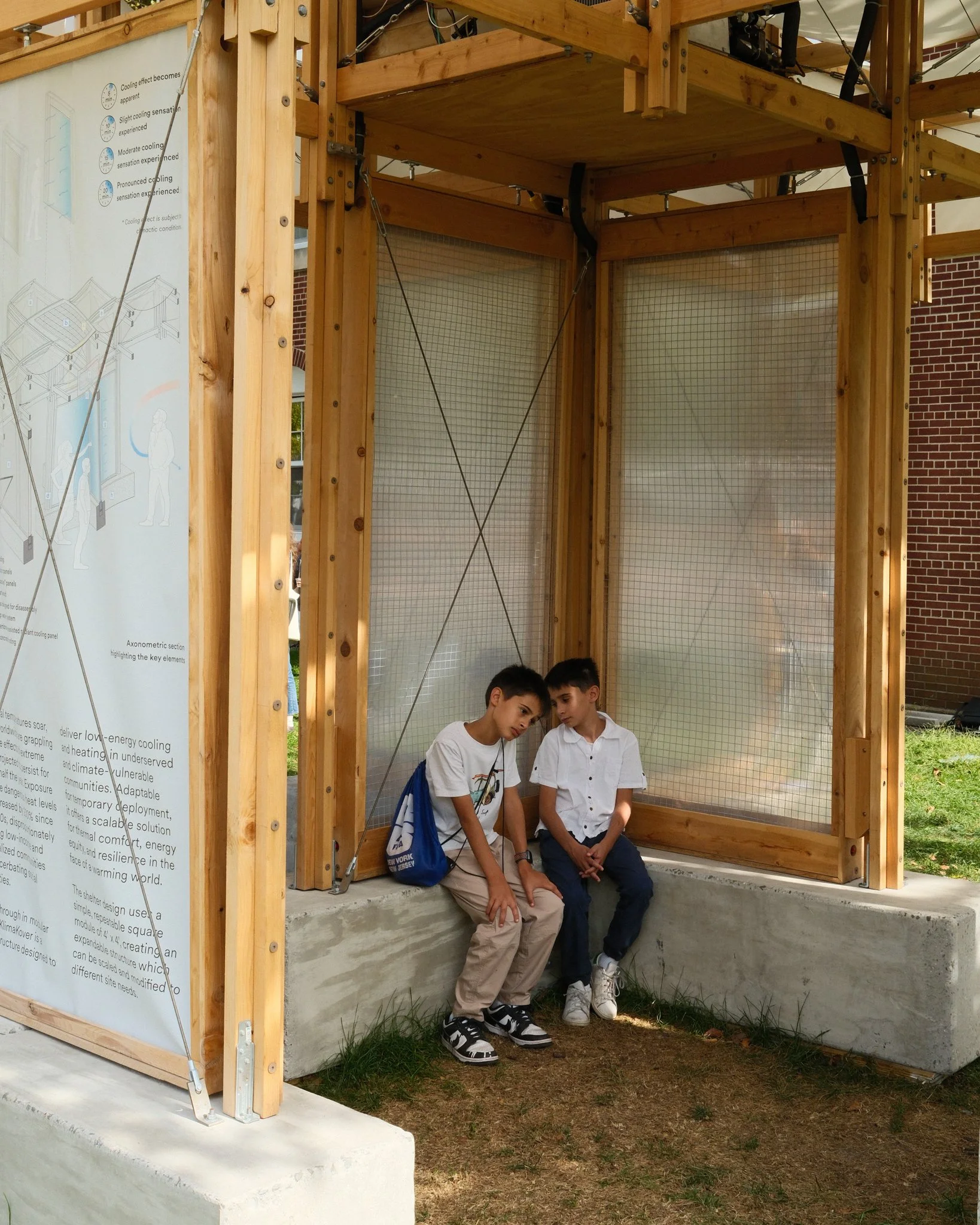
KlimaKover Cooling Shelter. Photography by Erick Reifer Marchak.
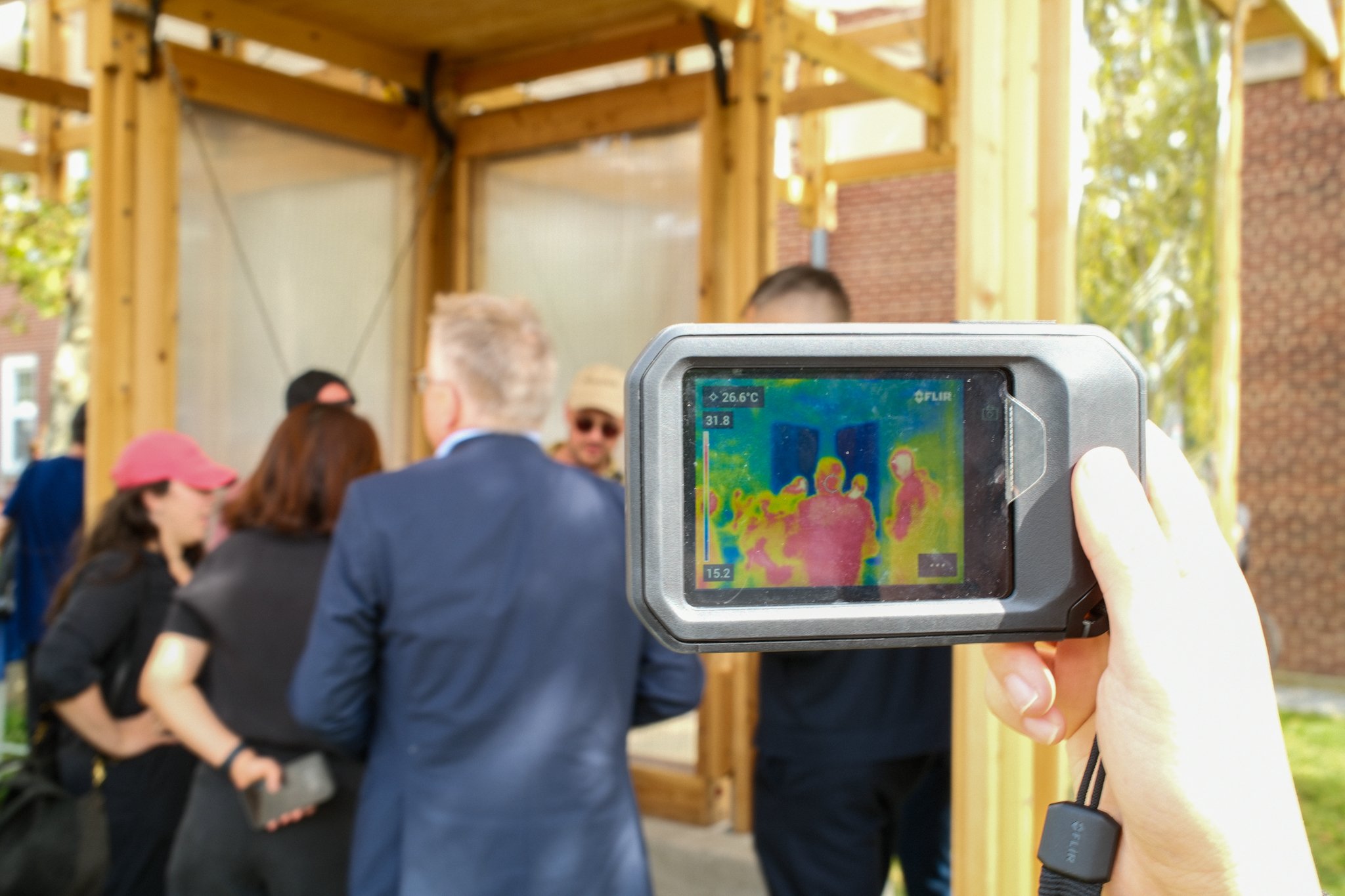
KlimaKover Cooling Shelter. Photography by Erick Reifer Marchak.
Looking back at it all, what have been the biggest challenges? How did you both manage through perceived disappointments or setbacks?
From my perspective, a typical week for someone in this role or in the sustainability and impact team usually consists of 90% disappointment or setbacks, and 10% wins. I know this ratio may look different in other geographies, but this is what it feels like in the US right now. Those 10% wins make it worth it though. My first year at Henning Larsen’s NYC team was also a journey for me and the team to understand how to work together, which always takes time and practice. We still haven’t cracked the recipe but have made so much progress. On each project, I have informal champions who lie at the project or design management level and their voices shape the sustainability ambitions and preserves the intentions.
I can only stay inspired and continue this journey by also remembering to take care of myself, and installing self-resiliency. Not all battles are worth fighting. Prioritization is important, as is taking things one step at a time and relying on the network of sustainability professionals helps me to reframe my strategy to make a case in front of a risk-averse client. Finally, the current lack of environmental policies and regulations and the erasure of critical relevant databases and resources is making it very tough for people in my seat to do their job. Our focus is on reframing the narrative and approaching it with a lens of innovation.
“...take the time to establish real relationships with people, and have patience to nurture the relationships to lay a foundation of trust. People help each other out, and it’s the network that will keep you sane when everything else starts malfunctioning.”
Who were your mentors through it all?
I come from an industrial city in Northern India, raised in a joint family of fourteen as many Indian families are. My eldest female cousin was not allowed to get higher education in a college outside of the city boundaries. And while my other female cousin was allowed to go for education outside of the city boundary, leaving the country was as absurd an ideas as flying cats. These two powerful predecessors, fueled by my mother’s demands, made a case for me being able to get an internship outside of India, pursue higher education, and even design a life of my own liking. So, while not a typical mentor on career-related topics but more of a champion on life and decision-making, my mother is the first of them all.
At Henning Larsen, I am very lucky to have mentors in my own team, even across the pond. Jakob Strømann-Andersen, our Director for Innovation and Sustainability, who I report to on global responsibilities, has been a mentor and supporter since the day I stepped in his team as an intern. He gave me opportunities that often people do not when they choose to focus more on age versus caliber. He has been the one shaping my outlook toward the world. Luck was also in my favor during grad school, where I got the honor of learning from Professor Holly Samuelson, and then continue working with her in various capacities throughout school.
Who are you admiring now and why?
Lauren Wang at the Trust for Governors Island has been a collaborator through the KlimaKover project. She leads climate piloting opportunities for urban climate solutions by providing testing ground at the island and facilitates climate action programs for people of all ages and backgrounds.
In the realm of materials, Jonsara Ruth and Allison Mears, co-founders of the Healthy Materials Lab Parsons School of Design, are such trailblazers and need no introduction. Every time I hear from them, I feel re-inspired and go back to work with a new will and direction. They have the superpower to break down scientific complexities to simple messaging and have produced such great work on healthy materials front.
Lastly, I am a huge fan of Lindsay Baker, who is the CEO of the International Living Future Institute. I am always amazed at the sheer determination she brings to impactful initiatives and establishes partnerships across sectors.

Downsview Framework Plan, Toronto, by Henning Larsen. Image courtesy of Aesthetica Studio.
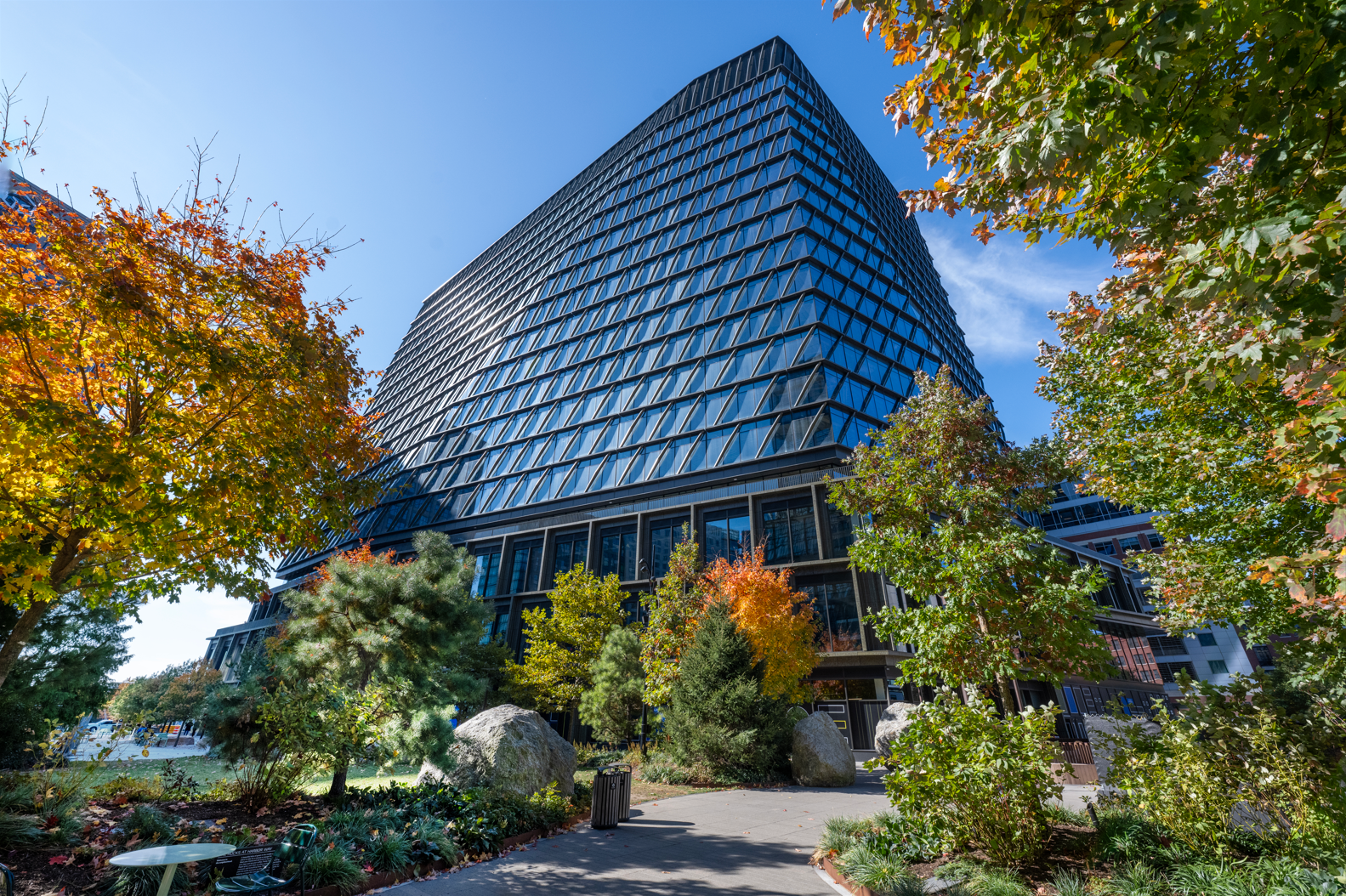
One Boston Wharf, Boston. Photography by Peter Vanderwarker.
What is the impact you’d like to have on the world? What is your core mission? And, what does success in that look like to you?
As the one who is ringing the alarm bell while getting continuous questions on why we need to retain the environmental features of a project when they cost extra, my goal is to move toward a world where a sustainable project is not necessarily a more expensive project. Apart from super necessary levers like policy, regulations and financing, one way to get there is to help scale the innovation happening in the world of materials and building technology. I want to use my position to bridge the gap between lab and implementation, from proof to deployment.
We have done that at Henning Larsen through projects like One Boston Wharf in Boston, MA, where Sublime Systems’ low-carbon cement was used for the first time commercially, even if it is a small volume. In Europe, we are now building a logistics Center for Bestseller, which will have a straw-based façade, supplied by EcoCocon. This is a new way of rethinking what logistics center and the warehouse and data center typology can look like — they don’t need to be the eye sore they are right now and can actually be a channel for positive environmental and social impact.
Finally, what advice do you have for those starting their career? Would your advice be any different for women?
I grew up feeling very conscious of my broad shoulders. I was abnormally broader than for average Indian woman and deliberately used to make myself smaller as to not stand out. Something changed as I gained confidence and found a constantly developing mission statement; I started taking up the space in a room that is rightly mine. It is still work in progress, but I see myself as an equal contributor in an industry that celebrates iconicity over impact.
Lastly, in the era of AI and efficiency, take the time to establish real relationships with people, and have patience to nurture the relationships to lay a foundation of trust. People help each other out, and it’s the network that will keep you sane when everything else starts malfunctioning.
This interview has been edited and condensed for clarity.