Meet Our Partners: Ayers Saint Gross' Principal Marina Carroll on Depth, Transparency and an Architect's Evolving Role
By Julia Gamolina
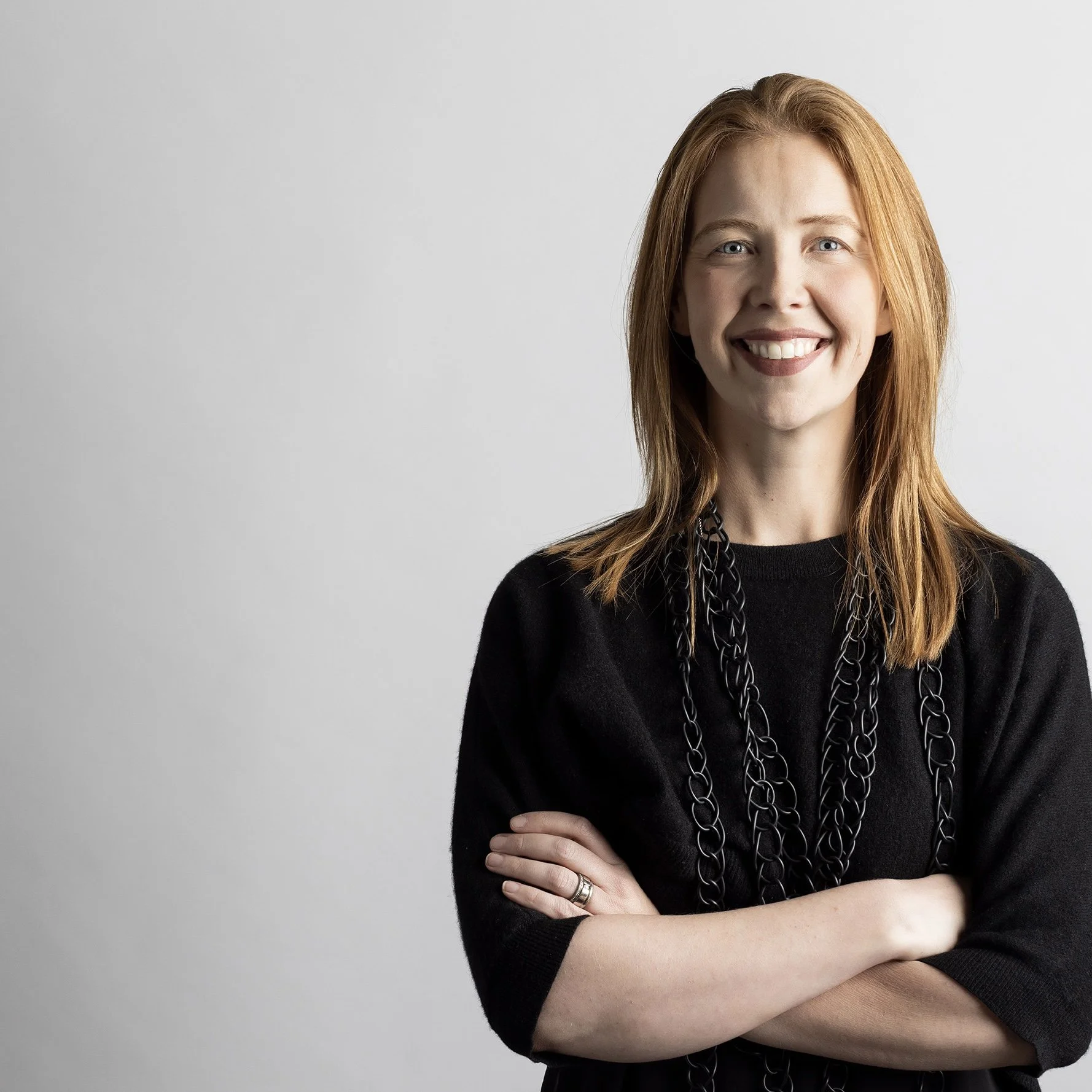
Marina Carroll is a Principal and Interdisciplinary Practice Lead at Ayers Saint Gross, where she works at the intersection of architecture, strategy, and institutional transformation. Known for translating complexity into clear direction, she advises higher education leaders on the future of campuses, student experience, and organizational resilience.
Originally from Australia and now based in New York, Marina combines design thinking with business strategy, informed by both architectural practice and an MBA. Marina is known for her illustrated reflections on architecture and culture, her interdisciplinary approach to practice, and her belief that architects are uniquely equipped to navigate complexity.
JG: We met at the Design for Freedom Summit at Grace Farms, and what immediately impressed me so much, other than our conversation, was your illustrated summary of takeaways that you posted afterwards on LinkedIn! I've seen you do this for a couple of other events you've attended, and as someone who focuses on business performance and organizational clarity, can you tell our readers why you do this, and why this is important to do?
MC: At events like the Design for Freedom Summit, there’s often an incredible amount of layered thinking compressed into a very short period of time. Design for Freedom, which focuses on eliminating forced labor from building supply chains, is fundamentally about revealing the invisible systems embedded within architecture. Those conversations can be intellectually dense, emotionally confronting, and deeply interdisciplinary. Drawing becomes a way for me to slow the ideas down and ask: what is actually happening here? What matters? What can we take away from this?
We live in a world drowning in information but starving for understanding, and architects are uniquely trained for that challenge. We are constantly absorbing competing inputs and trying to turn them into something coherent, actionable, and beautiful. In many ways, these illustrated summaries are simply an extension of the work I do professionally.
There’s also a broader intent behind why I share them publicly: not everyone gets to be in those rooms. I think there’s value in making important conversations more accessible, especially for visual thinkers. My two favorite things are sparking ideas and connecting people. Drawing and sharing does both.

Field Notes, Design for Freedom. Image by Marina Carroll Ayers Saint Gross.
You are an architect and also got your MBA in 2023, remaining in professional practice afterwards. Tell me why you wanted to pursue the degree and how what you’ve learned influences your role now.
Pursuing an MBA wasn’t about stepping away from architecture, but about expanding how I could contribute to it. Architecture taught me how to think spatially and conceptually, but institutions operate through far more than design alone. They are shaped by governance, finance, operations, demographics, politics, technology, and human behavior.
At my previous role at Architectus, I found myself leading a team of roughly 100 people and overseeing around 20% of the company’s revenue. I realized very quickly that I wasn’t just helping shape projects anymore; I was helping shape a business. I took that responsibility seriously and I wanted greater fluency in the conversations happening around strategy, financial performance, organizational leadership, and long-term growth.
That dual perspective has become incredibly valuable in my role at Ayers Saint Gross. We’re not simply designing buildings; we’re helping mission-driven institutions navigate change and make long-term decisions about their future. My MBA shifted my thinking from individual projects toward broader institutional frameworks.
What was some of the best advice you got early on that has informed your approach to your work and career?
I still remember the moments before Ruth Wilson, a longtime mentor, friend, and Director of Architectus, and I walked into a meeting that already felt lost before it had begun. People had arrived ready to defend positions rather than solve problems. Just before we went in, Ruth turned to me and said, “Let’s kill them with kindness.” What unfolded over the next hour was one of the most extraordinary displays of leadership I have ever witnessed. Ruth greeted them with warmth, humor, and goodwill. She didn’t attempt to overpower anyone with status, volume, or ego. Instead, she disarmed the tension completely through generosity, composure, curiosity, and respect. She acknowledged concerns without surrendering her position. And slowly, almost imperceptibly, the atmosphere changed. People softened, defensiveness gave way to dialogue, and positions became conversations. The meeting that had begun with confrontation ended with alignment. What struck me most was that Ruth was not avoiding conflict, but mastering it.
The phrase “kill them with kindness” can often be mistaken for passivity or conflict avoidance. In reality, it requires enormous emotional discipline. It means refusing to escalate tension simply because tension is offered to you. It means staying composed when others become reactive. It means understanding that confidence does not need to perform aggression to prove itself. The best leaders I have known operate differently — they are generous, measured, and calm under pressure. Their authority comes not from dominance, but from control of themselves. Ruth taught me that warmth, when paired with clarity and conviction, is the most powerful leadership tool.
“We live in a world drowning in information but starving for understanding, and architects are uniquely trained for that challenge. We are constantly absorbing competing inputs and trying to turn them into something coherent, actionable, and beautiful.”
Tell me about your professional experiences before joining Ayers Saint Gross. What did you learn with each step?
In the same way that architects shape projects, projects shape architects too. My career really started at the Royal Children’s Hospital in Melbourne. I was probably the most junior person on the entire fifty-person team, and I was assigned the design of the dot pattern on the facade, in addition to taking meeting minutes. But I learned the currency of making yourself useful and discovered that competence, reliability, and curiosity opened doors.
The MacMahon Ball Theatre project at the University of Melbourne was the project I got registered on. It was a small renovation project with a tiny site, a tight budget, and countless restrictions. I learned though that constraints often sharpen ideas rather than limit them. You stop chasing excess, start focusing on precision, and exploring the edges.
Macquarie University 1CC became one of the defining projects of my career. It was a major campus transformation effort where my own ambitions around pedagogy, student experience, and spatial strategy aligned deeply with the university’s leadership. I never believe architects should impose their own agenda onto institutions as our role is to inspire and help clients shape the best version of their vision. But occasionally your thinking converges with theirs so strongly that something genuinely magical happens. That project fundamentally shaped how I think about higher education as an ecosystem.
Moving from Australia to the United States was also a defining transition. Australia gave me an incredible foundation, but the scale and diversity of the U.S. higher education sector are extraordinary. And then, of course, there are my two little boys. Definitely my cutest project. They taught me that architecture is easy.

Arts West, University of Melbourne by ARM + Architectus. Image John Gollings.

Royal Children's Hospital by Bates Smart +Billard Leece. Image John Gollings.
Looking back at it all, what have been the biggest challenges? How did you both manage through perceived disappointments or setbacks?
Architects are a remarkably resilient group of people. Projects stall, funding disappears, new constraints emerge, and teams are asked to chart a new path. Earlier in my career, whenever an issue surfaced, my instinct was often to immediately think that it is all my fault. While accountability is important, I eventually realized that reflex was neither useful nor often true. Effective leadership isn’t about carrying all the blame personally; it’s about taking responsibility for helping move things forward constructively.
One of the biggest lessons I’ve learned is the importance of transparency. Bad news does not improve with time. Whether it’s with clients, project teams, or leadership, I strongly believe in being candid, communicating early, reflecting honestly, and addressing issues directly before they become larger than they need to be. Some of the strongest relationships and best project outcomes I’ve experienced have emerged from difficult moments that were navigated honestly and thoughtfully.
Who were your mentors through it all?
Since moving to New York, Frances Halsband and Joe Juliano have both been enormously generous. Frances is an industry legend and has an extraordinary ability to combine intellectual rigor with warmth and candor. Joe Juliano, Vice Provost for Planning and Academic Operations at NYU, has also been an important sounding board as I’ve navigated the U.S. higher education landscape.
At Ayers Saint Gross, Adam Gross is my reason for being here and has become an important creative sparring partner. I often think that to reinvent the wheel, you first need to understand how it turns. Ayers Saint Gross has been specializing in Higher Education for over forty years and is the embodiment of the idea that innovation doesn’t emerge from nowhere. That balance between deep expertise and curiosity about what comes next is something I value enormously.
I’m also increasingly inspired by younger colleagues and emerging leaders like architects Jason Hearn, Marie McKenna, Katie McRury, and Danny Yontz, who challenge my assumptions by teaching me new things and pushing me to rethink practice through new lenses.
“One of the biggest lessons I’ve learned is the importance of transparency...Some of the strongest relationships and best project outcomes I’ve experienced have emerged from difficult moments that were navigated honestly and thoughtfully. ”
Who are you admiring now and why?
I deeply admire Shannon Dowling, an Ayers Saint Gross principal, architect, space analyst, and educator, for the way she connects architecture to measurable educational outcomes. Shannon is rigorously exploring how design influences belonging, retention, connection, and student success. That’s incredibly important work because universities are no longer simply competing on facilities — they are competing on experience, community, and human outcomes.
I’m also consistently inspired by J. Meejin Yoon of Höweler + Yoon, and the way her practice moves fluidly between architecture, art, research, technology, and public engagement. There’s a thoughtfulness and intellectual curiosity in her work that I find incredibly compelling.
Outside architecture, I admire Martin Weigel in the advertising world for his ability to communicate complex ideas with clarity, humor, and emotional punch. And perhaps unexpectedly, I love David Sedaris. His writing is hilarious, deeply observant, and profoundly human. He notices people carefully, and good architects do the same. Design ultimately starts with observation, empathy, and understanding human behavior in all its awkwardness and complexity.
What is the impact you’d like to have on the world? What is your core mission? And, what does success in that look like to you?
My core mission is to help universities and mission-driven organizations make braver, smarter, and more beautiful long-term decisions about how their campuses evolve. I’m drawn to higher education because universities shape far more than individual students; they shape research, culture, public discourse, innovation, and civic life.
I’m also deeply interested in helping shape what architecture becomes over the next few decades. The role of architects is expanding dramatically in that we are no longer simply designers of objects. Increasingly, we are translators, strategists, facilitators, systems thinkers, and cultural interpreters operating within extraordinarily complex environments.

Jack C Taylor Visitor Center at Missouri Botanical Garden by Ayers Saint Gross, Image by Casey Dunn.
Finally, what advice do you have for those starting their career?
My biggest advice for people starting their careers is to engage with the broader design community, curiously and generously. So many opportunities in my own career emerged through new and existing relationships and extended networks, particularly after moving to the United States.
I’d also encourage people to build depth somewhere. Architecture is incredibly broad, and over time, I realized that developing expertise within higher education gave me both focus and differentiation. Pairing that with an MBA created a unique bridge between design thinking and institutional strategy that became central to my career. And trust that your perspective has value. Diverse voices are not just beneficial to architecture; they are essential to producing better outcomes, better institutions, and ultimately a better built environment.
And finally, like I said earlier, transparency matters. One of the things I respect about Ayers Saint Gross is the firm’s commitment to participating in the JUST Label program, which publicly discloses metrics around equity, diversity, inclusion, pay equity, and organizational culture. The data doesn’t always tell a perfect story, and that’s precisely the point. Progress starts with visibility, honesty, and accountability. Creating a more equitable profession requires more than good intentions; it requires institutions willing to examine themselves openly and keep doing the work.
This interview has been edited and condensed for clarity. “Meet Our Partners” is a sponsored editorial series featuring organizations that support Madame Architect’s mission.